What to take away
- 01It is the highest-utilisation attachment most contractors own, because almost every site has material to move.
- 02Tine count is the retention argument: five tines hold brash and biomass that four-tine grapples spill.
- 03Rotation is most of the productivity difference — it lets the operator align to a log without repositioning the machine.
Cut a tree and it has to be moved. Clear a site and the brash has to go somewhere. Run a chipper and something has to feed it. Build a log deck and something has to stack it. That is why grabs are the attachment with the highest annual hours in most forestry fleets, and why they are usually the right first purchase for a contractor entering this space.
What separates a forestry grab from a general-purpose grab
Demolition and sorting grapples look similar and are built for different loads. A forestry grab is designed around three specifics:
Tine geometry for round material. Logs roll. Tines have to close around a curved surface and hold it under rotation, not just squeeze a flat one.
Structural resilience to point loading. Brash and irregular timber load tines unevenly. A grapple designed for even bucket-style loading cracks.
Volume for low-density material. Brash and biomass are bulky and light. A grab sized only by weight capacity will be too small to be productive.
Two ranges, two jobs
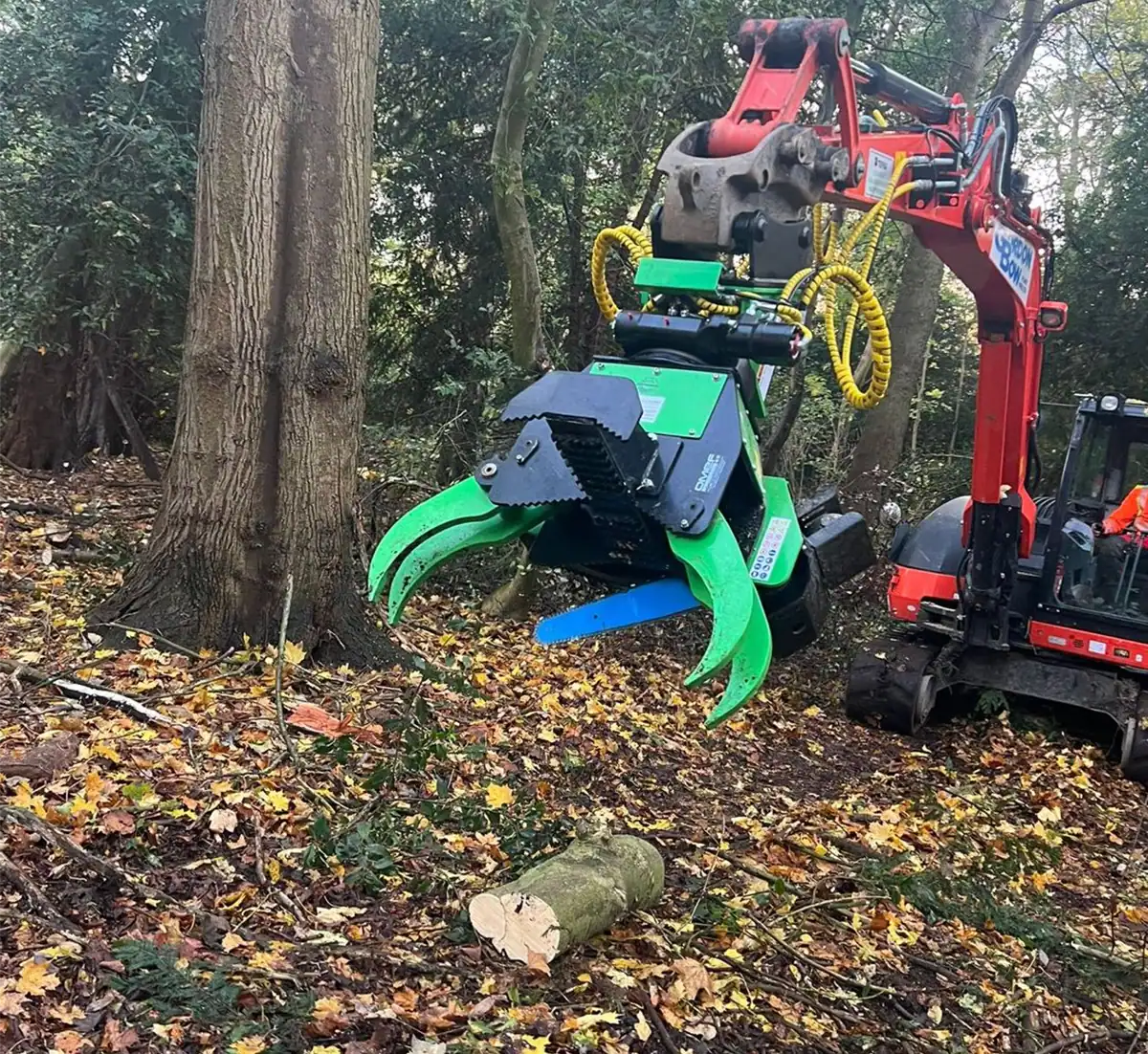
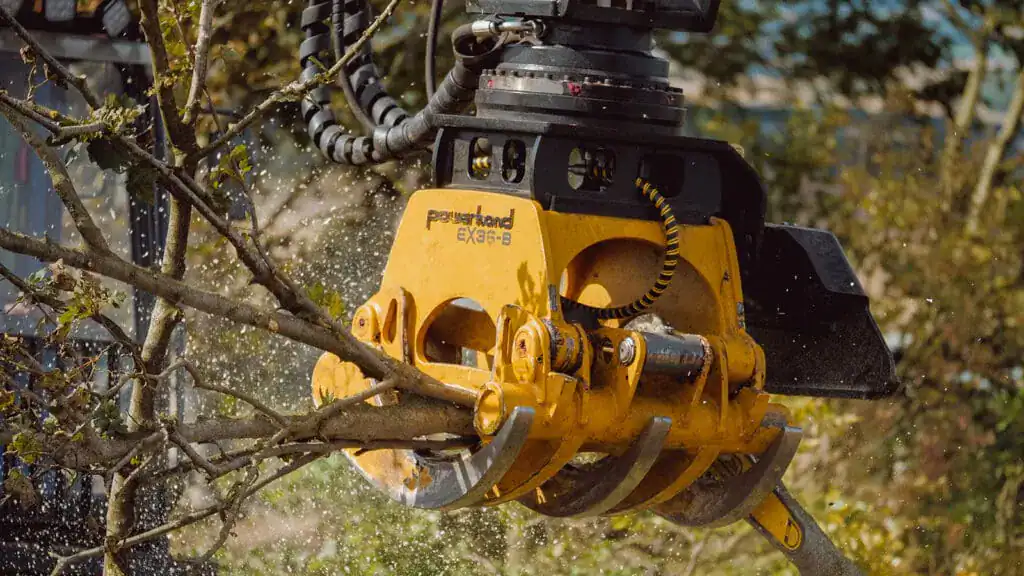
Powerhand EX Series forestry grapple
The heavy biomass tool.
| Parameter | Detail |
|---|---|
| Carrier range | 13 to 25 t excavators, or large crane |
| Tines | Five solid 50 mm Hardox tines |
| Mounting, rigid | Direct, via tilt rotator or rigid rotator assembly |
| Mounting, swing | Swing link available |
| Designed for | Feeding chippers, handling brash during site clearing, log handling, general forestry |
Two details matter commercially. Five tines, not four. More contact points means better retention on brash and irregular material, which is exactly where four-tine grapples spill. Solid 50 mm Hardox is a structural choice aimed at the punishment brash handling inflicts.
This is also the grapple the Powerhand grapple saw mounts onto. If you expect to add cutting later, that upgrade path is the reason to start here.
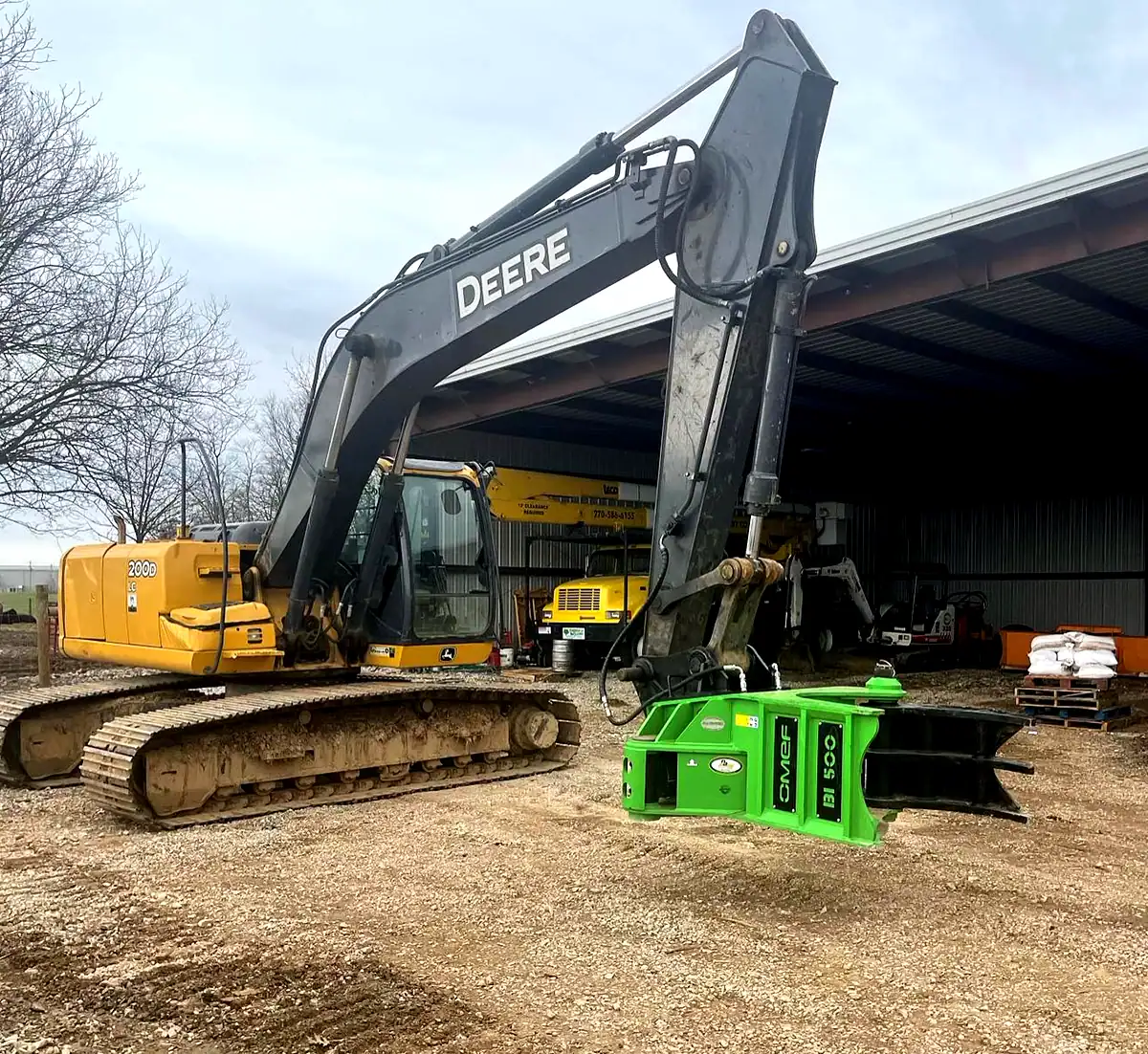
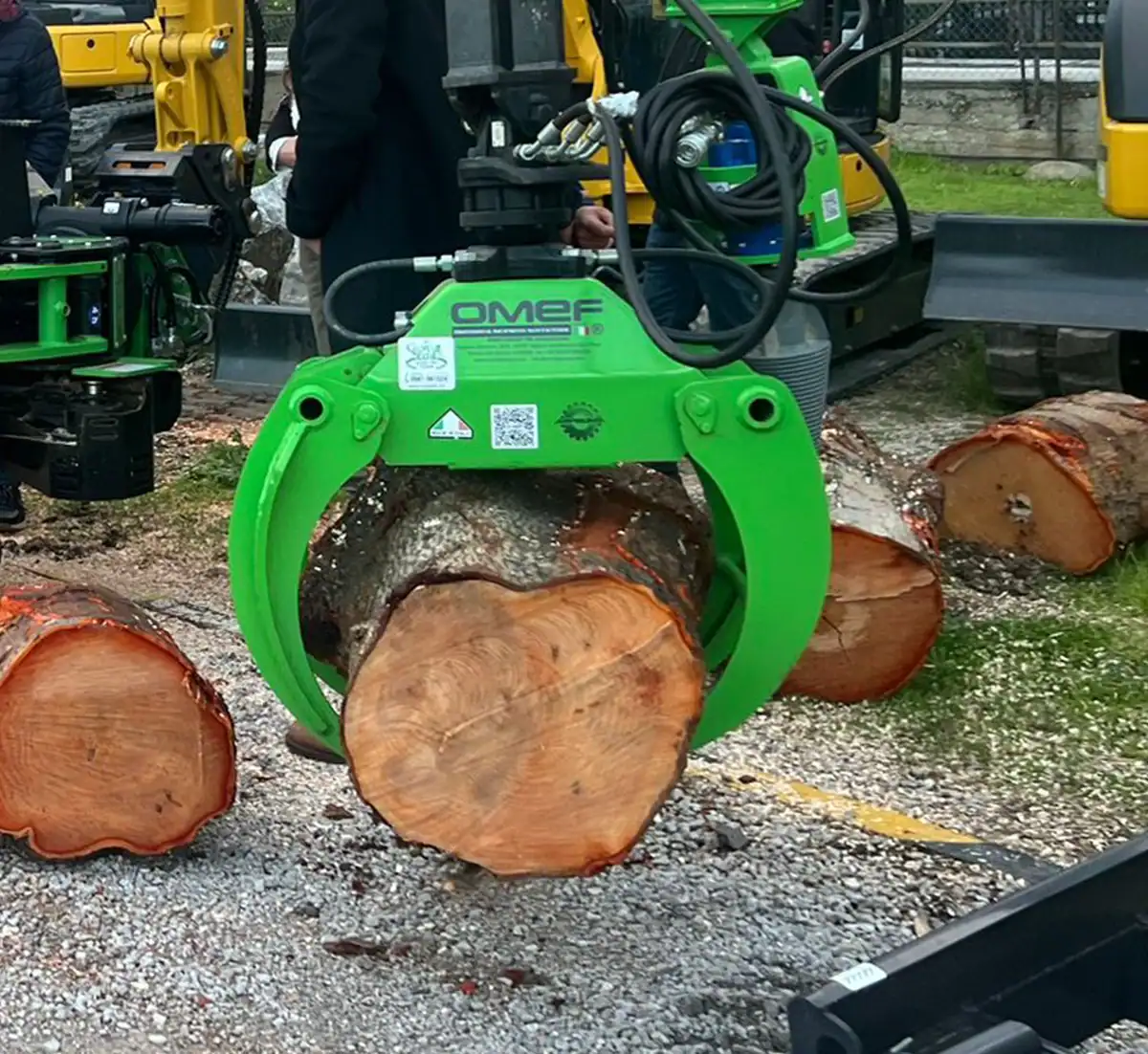
OMEF PFIMX Series log grapple
The lighter, broader-carrier tool.
| Parameter | Detail |
|---|---|
| Mounts on | Excavators, backhoe loaders, telescopic handlers, tractors |
| Tip options | OPEN or CLOSED |
| Hydraulics | Double-acting line |
| Safety | Integrated block and relief valve on all models except the 1000R |
| Heavy duty models | 1400HD, 1600HD and 1800HD add lateral claw reinforcements and a double-box reinforcement frame |
| Supply | Turnkey kit with machine-specific bracket and hose kit available |
Specifications are supplier-published and subject to change.
Open tips or closed tips: get this right
This is the specification buyers skip and then regret.
OPEN tips give maximum versatility on irregular or uneven logs, and better precision in tight or confined spaces. Choose these if your material is mixed, your sites are constrained, or you handle a lot of non-uniform timber.
CLOSED tips give superior stability and safety when gripping large or heavy logs. Choose these for loading, storage and controlled movement of uniform timber.
The decision rule: open for messy work, closed for uniform work. If most of your material is storm debris, mixed clearing waste and irregular stems, open. If most of it is graded logs going onto a truck or a deck, closed.
The commercial case
Grabs are the easiest business case in this guide, for a simple reason: they turn an excavator you already own into a materials handler for a fraction of the cost of a dedicated one.
The three arguments:
Utilisation. A grab works on clearing jobs, tidy-up jobs, loading jobs, chipper-feeding jobs and storm response. Very few days where it is on the machine are days it does not earn.
Cycle time on chipper feeding. Manual feeding is slow and it is the single highest-risk task in green waste processing. A grab both accelerates and de-risks it.
Equipment substitution. Compare the purchase to a dedicated forestry loader or materials handler. The gap is very large, and for most Australian contractors the grab-on-existing-excavator answer is the right one until volumes justify a purpose-built machine.
Rotators, tilt rotators and where the money goes
Mounting choice has a bigger effect on productivity than tine count does.
Rigid mount. Cheapest. The grapple is fixed relative to the stick. Positioning requires machine movement. Fine for straightforward loading.
Rotator. Continuous rotation. The productivity step change for anything involving stacking, sorting or feeding. This is where most of the value is.
Tilt rotator. Rotation plus tilt. Maximum capability, maximum cost, maximum hydraulic complexity, and a genuine operator training requirement.
The Powerhand EX series supports rigid mounting directly via a tilt rotator or rigid rotator assembly, or swing link mounting. Decide which before ordering, because the mounting arrangement is not trivially changed later.
Running cost
Pins and bushes. The main wear item. High cycle counts and dirty conditions. Budget for a pin and bush program rather than reacting to slop.
Tine tips. Ground contact wears tips. Some operators use grabs to rake and scrape, which is faster than they think and more expensive than they think.
Rotator seals and hoses. If you specify rotation, this becomes your main maintenance line. Internally routed hoses on the higher-spec assemblies exist for exactly this reason.
Cylinder seals. High cycle count, exposed environment, abrasive dust. Normal wear, plan for it.
Grabs are the cheapest attachment in this guide to run. That is part of why they earn their keep.
The honest limitations
- A grab is not a lifting device. Handling timber under a grapple is not the same as certified lifting. Do not let it drift into crane work without the right equipment and paperwork.
- Load at radius is the real constraint. Weight plus load at full extension is what tips machines. Check your lift chart, not the attachment brochure.
- Wrong tip choice is a permanent annoyance. Open tips on uniform log loading feel imprecise. Closed tips in confined mixed work feel clumsy. Pick correctly.
- The 1000R has no integrated block and relief valve. If you are considering that model, understand what that means for your circuit protection.
- Rotation is addictive and expensive. Once operators have it, they will not go back. Budget accordingly.
Buy, hire or subcontract
Grabs are the one category where the answer is usually just: buy.
| Situation | Route |
|---|---|
| Any recurring forestry, clearing or green waste work | Buy. Utilisation is high enough that hire rarely makes sense. |
| Single project | Hire, if you can find one |
| Planning to add a grapple saw later | Buy the EX series and take the upgrade path |
| Mixed fleet including telehandlers and tractors | PFIMX, because it mounts across more carrier types |
Compliance notes
Quick hitches must meet AS 4772-20081 or an equivalent such as ISO 13031-2016 with a secondary safety system, and this matters because grabs carry suspended loads over ground where people work. Exclusion zones under suspended timber are not negotiable. Operator protection to ISO 8084 applies where material is handled near the cab, which with brash is most of the time.
Questions to ask before you sign
- Open or closed tips for my material mix, and can I change later?
- What is the tine count, tine thickness and steel grade?
- Is a block and relief valve fitted to this specific model?
- Rigid, rotator or tilt rotator, and what does each do to my hydraulic requirement?
- What is the grapple's weight, and what does that leave me at full reach on my lift chart?
- Does the quote include the turnkey kit with machine-specific bracket and hose kit?
- If I add a grapple saw later, does this grapple accept it?
In the field
Frequently asked questions
01What is a forestry grab used for?
Handling logs, brash and biomass. Typical tasks include feeding chippers, clearing brash from sites, log handling, stacking and loading, and general forestry work.
02What size excavator do I need?
The Powerhand EX series is designed for 13 to 25 tonne excavators or large cranes. The OMEF PFIMX series mounts across a broader range of carriers including excavators, backhoe loaders, telescopic handlers and tractors.
03What is the difference between open and closed tips?
Open tips give better manoeuvrability and versatility on irregular logs and in confined spaces. Closed tips give better stability and safety when gripping large or heavy timber for loading, storage and controlled movement.
04What hydraulics does a log grapple need?
The PFIMX operates on a double-acting hydraulic line for opening and closing. Adding rotation requires additional supply, which should be confirmed against your carrier.
05How many tines should a forestry grapple have?
More tines give better retention on irregular and bulky material. The Powerhand EX series uses five solid 50 mm Hardox tines, which suits brash and biomass work where four-tine grapples tend to spill material.
References
- 1Standards Australia / WorkSafe Victoria — AS 4772 — Earth-moving machinery quick hitchesQuick hitch safety system requirement
Keep reading
This category is most often confused with one other: