What to take away
- 01The category exists to take people out of the tree. That is the safety case and the commercial case at once.
- 02It typically needs a dual circuit: a saw line plus a separate grapple and rotation supply, valve-controlled.
- 03Flow is the constraint. The OMEF GS range spans 15 to 50 L/min on the smallest model up to 160 L/min on the largest.
Read that again, because the commercial argument for this category is not speed. It is that a grapple saw removes the need for a person to be in the tree, or standing under it, on the jobs where that was previously unavoidable.
Who this is for
Urban and municipal tree removal. Trees over houses, over roads, over power infrastructure. The work where the cost is not the cutting, it is the rigging, the traffic control and the risk.
Storm and emergency response. Windblown and hung-up trees are where climbing risk peaks. A machine that can reach in and take a controlled bite changes what you can safely accept as a job.
Forestry site clearance. Cross-cutting oversized timber, processing windblown areas, tidying stems into handleable lengths.
Rail and road corridor work. Short possession windows, no tolerance for uncontrolled drops.
If your work is straight production felling in open ground, a tree shear is faster and cheaper. Grapple saws earn their money where control is worth more than speed.
Two ranges, two philosophies
Machinery Specialist supplies both. They solve the problem differently.
Powerhand Grapple Saw EX Series
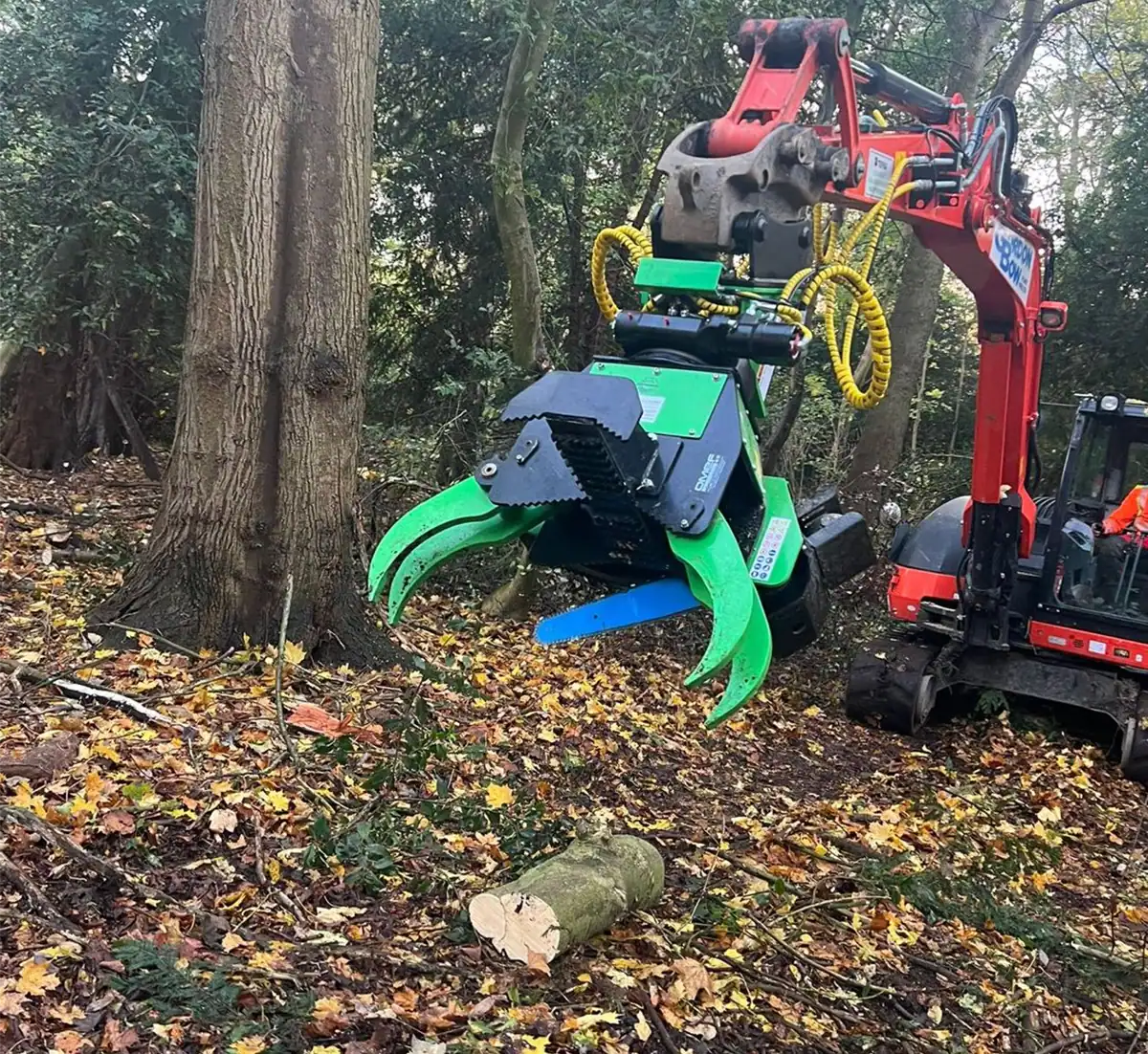
A saw unit that mounts onto the Powerhand EX series grapple, converting an existing biomass grapple into a cutting tool.
| Parameter | Detail |
|---|---|
| Models | 3 |
| Unit weight | 165 kg to 254 kg |
| Carrier range | 8 to 30 t excavators |
| Jaw opening | 1,410 mm |
| Hydraulic requirement | One flow and return service |
| Chain options | 0.404" or 3/4" pitch harvester chain cassettes |
| Rotator, swinging | Indexator GC124S |
| Rotator, rigid | XR400 |
| Rotation | 360° continuous, internally routed hoses |
| Built-in | Automatic bar return, chain tensioning, lubrication |
The commercial logic here is incremental. If you already run or are buying an EX series forestry grab, the saw unit adds cutting to a tool you already own. Single hydraulic service keeps the installation simple.
OMEF Grapple Saw GS Series
A purpose-built grapple saw with a much wider carrier range, including small machines.
| GS250 | GS400 | GS600 | GS800 | |
|---|---|---|---|---|
| Carrier | 3 to 6 t | 5 to 10 t | 12 to 22 t | 22 to 30 t |
| Weight | 230 kg | 410 kg | 860 kg | 1,650 kg |
| Max cutting diameter | 250 mm | 400 mm | 600 mm | 800 mm |
| Max load | 400 kg | 1,500 kg | 2,200 kg | 3,000 kg |
| Max arm length | 430 mm | 950 mm | 1,450 mm | 2,200 mm |
| Pressure | 200 to 250 bar | 220 to 250 bar | 250 bar grapple+saw, 180 bar rotation | 250 bar grapple+saw, 200 bar rotation |
| Flow rate | 15 to 50 L/min | 30 to 60 L/min | 70 to 100 L/min, plus 40 L/min rotation | 160 L/min, plus 70 L/min rotation |
| Saw chain | .404" | .404" | .404" | 3/4" |
| Bar length | 400 mm | 550 mm | 750 mm | 1,050 mm |
| Drive motor | Parker piston 11 cc | Parker piston 11 cc | Parker piston 10 cc | Parker piston 30 cc |
| Rotation | 360° | 360° | 360° | 360° |
| Mounting | Excavator, telehandler | Excavator, telehandler | Excavator | Excavator |
Specifications are supplier-published and subject to change without notice.
Read the flow column before anything else
That table contains the number that kills most grapple saw purchases, and it is not the price.
Look at the jump between GS400 and GS600. Flow requirement goes from 30 to 60 L/min up to 70 to 100 L/min for the grapple and saw circuit, with a further 40 L/min for rotation on a separate supply. GS800 asks for 160 L/min plus 70 L/min for rotation.
Most standard excavators in Australia are plumbed with a single breaker circuit. A grapple saw needs more than that. The OMEF GS operates on two hydraulic lines: a single-acting line for the chainsaw bar, and a double-acting line controlled through a solenoid valve for grapple movement and 360° rotation of the slewing ring.
Before you get a quote, confirm three things with your machine dealer:
- Do you have a second auxiliary circuit, or can one be fitted?
- What is your actual available flow at the coupler, at temperature, under load?
- Can your control system run a solenoid valve arrangement for the grapple and rotation functions?
If the answer to any of these is no, the attachment purchase has a machine modification attached to it. Find that out before you sign, not after delivery.
The commercial case
The honest version has three parts.
Risk transfer. Work that required a climber, a crane or a traffic closure can sometimes be done from the ground with one machine and one operator. That is not a marginal efficiency gain, it is a different cost structure on a different job type.
Crew size. A removal that took a climber, two groundies and a chipper crew can shrink. Not to zero, but meaningfully.
Access to work you currently decline. Same argument as the tree shear, and it is usually the one that makes the number work. Storm response, hazardous trees, hung-up stems.
The part that does not hold up: grapple saws are not faster than a good climber on every job. On a tight suburban block with no machine access, the climber still wins. Buy the tool for the jobs it changes, not for the jobs it duplicates.
Running cost
Chain and bar. The dominant consumable, and it is a frequent one. Harvester chain in .404" or 3/4" pitch is not hardware-store chainsaw chain, and pricing reflects that. Automatic chain tensioning and lubrication on the Powerhand units help, but they reduce wear, they do not remove it.
Dirt. Cutting near ground level or through bark carrying grit destroys chain fast. Operator technique has a direct, measurable effect on your chain bill.
Rotator. The most expensive single component after the saw motor. Internally routed hoses on both the Indexator GC124S and the XR400 exist to stop hose damage, which is the failure that most often takes these units off the job.
Hydraulic contamination. Dual-circuit systems with solenoid control are less forgiving of dirty oil than a simple hammer line. Filtration discipline pays for itself.
The honest limitations
- Reach is the real constraint. Your working envelope is your excavator's envelope. A grapple saw does not make a 5 tonne machine reach 12 metres.
- Carrier stability under load. Look at the max load column. A GS600 holding 2,200 kg at full extension imposes a real stability requirement. Check your lift chart at radius.
- Hydraulic complexity is a maintenance load. More circuits, valves and rotation seals than any other category in this guide.
- It is not a delimber or a processor. It cuts and holds. Volume timber processing is a different machine class entirely.
- Operator skill matters more than in any other category. Bad technique costs you chains, bars and, eventually, hydraulic components.
Buy, hire or subcontract
| Situation | Route |
|---|---|
| Occasional hazardous removals | Subcontract to a specialist |
| Regular urban removal work, existing excavator | Buy, after confirming your hydraulic circuit |
| You already own an EX series grab | Powerhand saw unit is the cheapest path in |
| Storm response contracts | Buy. Availability is the product you are selling. |
Compliance notes
Quick hitches must meet AS 4772-20081 or an equivalent such as ISO 13031-2016 with a secondary retention system. That requirement is at its most serious here: a grapple saw carries load at height, over the exclusion zone, frequently near assets or traffic.
Operator protection under ISO 80842 is directly relevant because the cut happens in the operator's working plane. Note the standard's limitation, which is worth knowing rather than glossing over: it excludes broken chainsaw teeth from its scope.
Where the work is amenity pruning rather than removal, AS 4373 governs the cut quality and is routinely written into council and utility specifications.
Questions to ask before you sign
- What exact flow and pressure does this model need, on which circuits?
- Does my machine have, or can it take, a second auxiliary circuit and solenoid control?
- Which rotator is specified, rigid or swinging, and what does it cost to replace?
- What is the Australian price and lead time on chains, bars and saw motors?
- Is the grapple saw supplied with a machine-specific mounting bracket and hose kit?
- What is the maximum load at full arm extension, and does my lift chart support it?
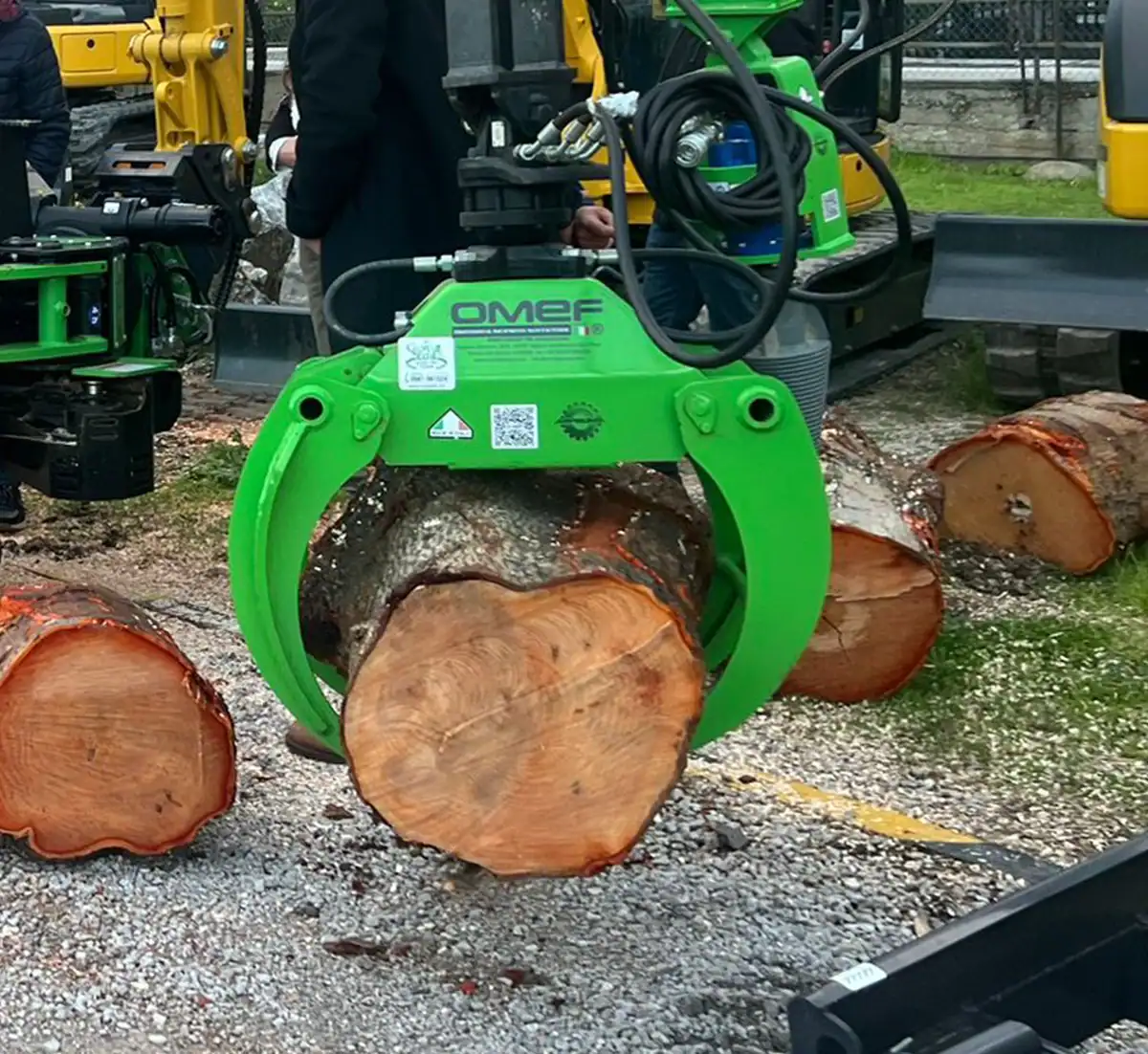
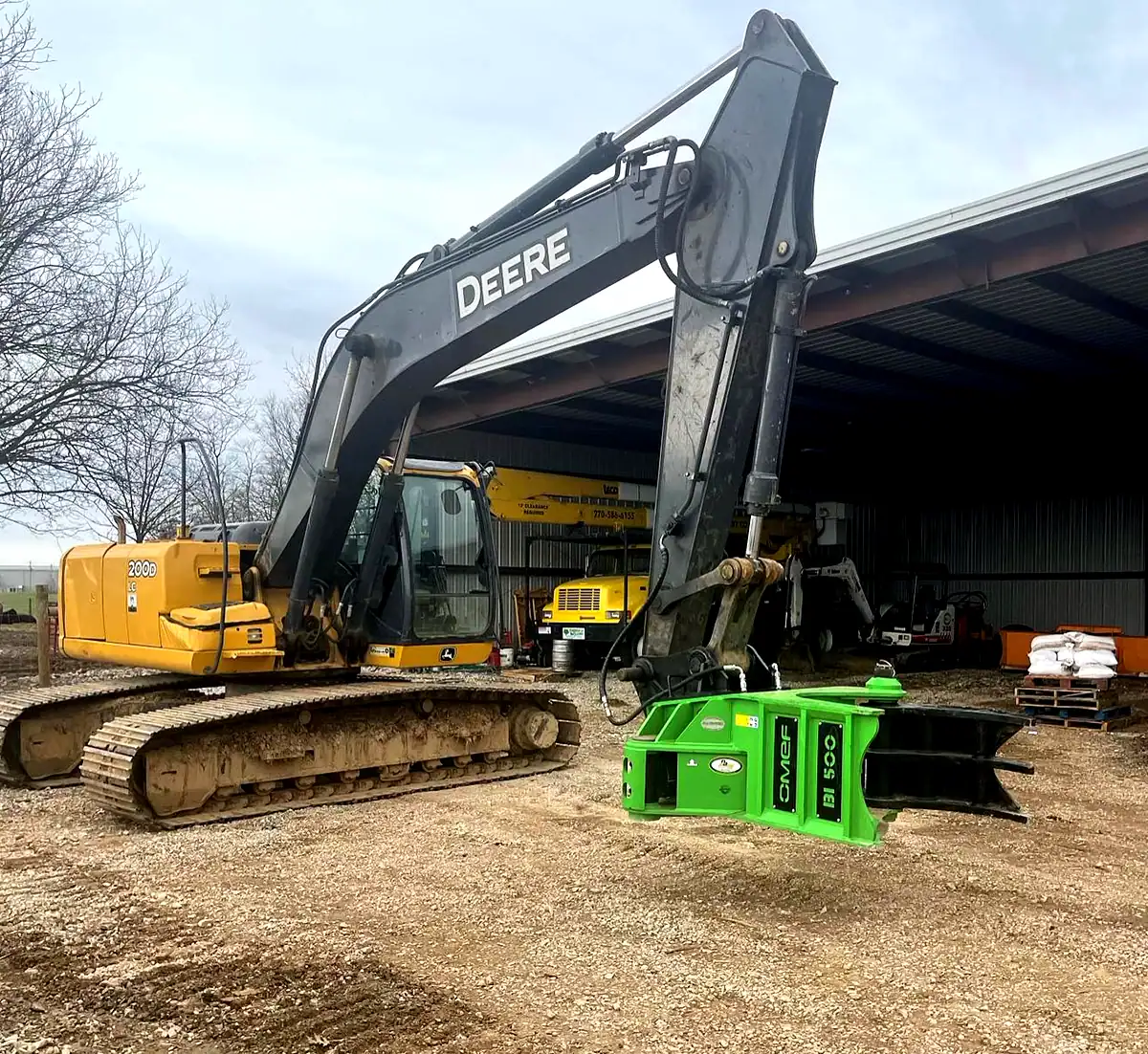
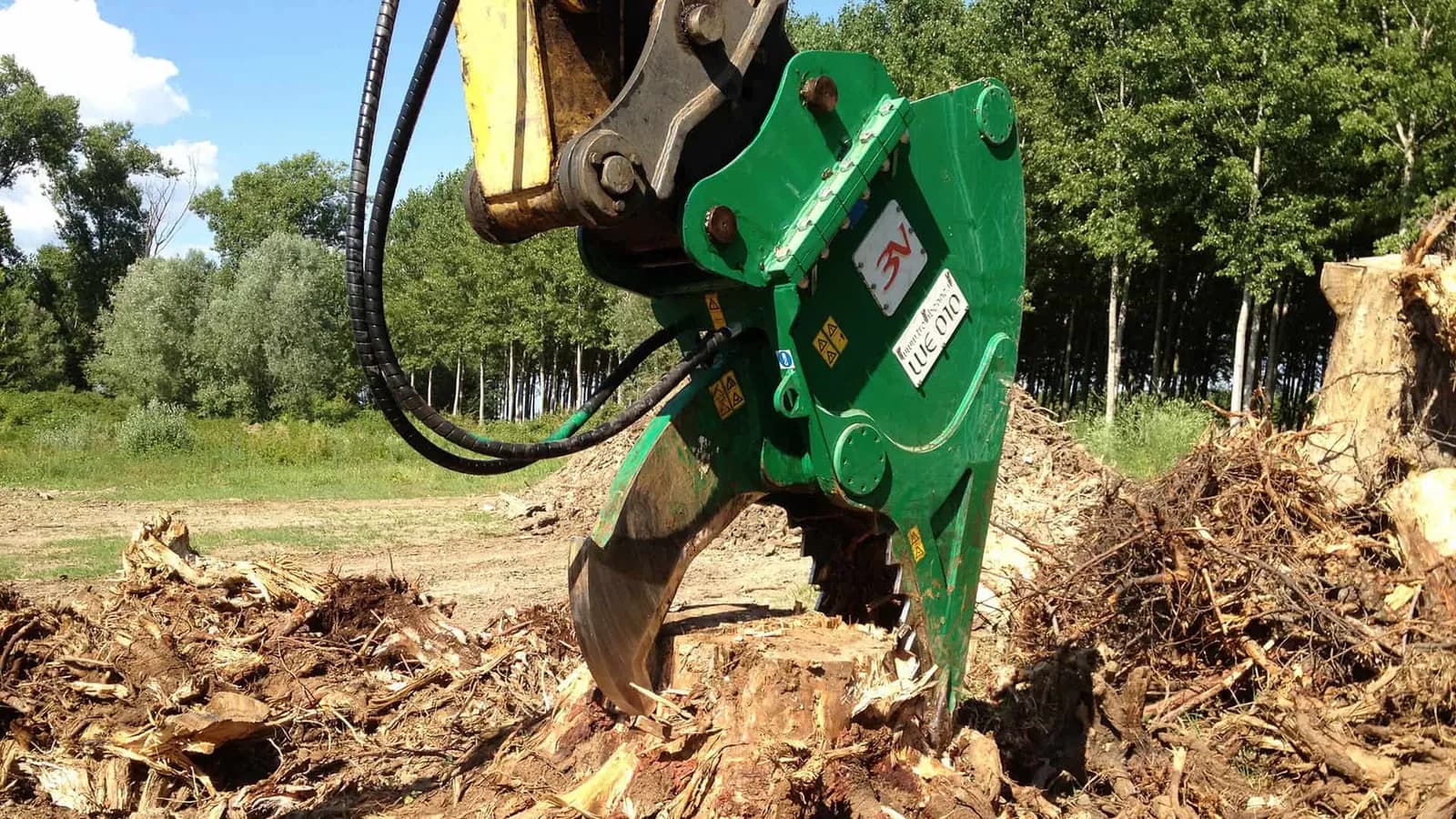
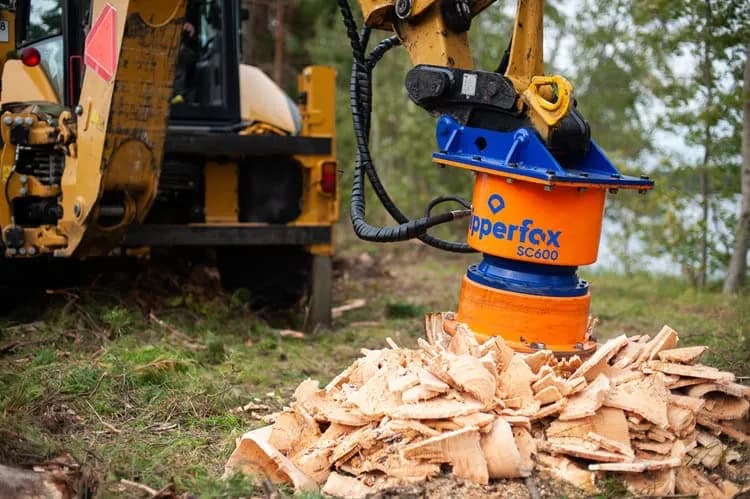
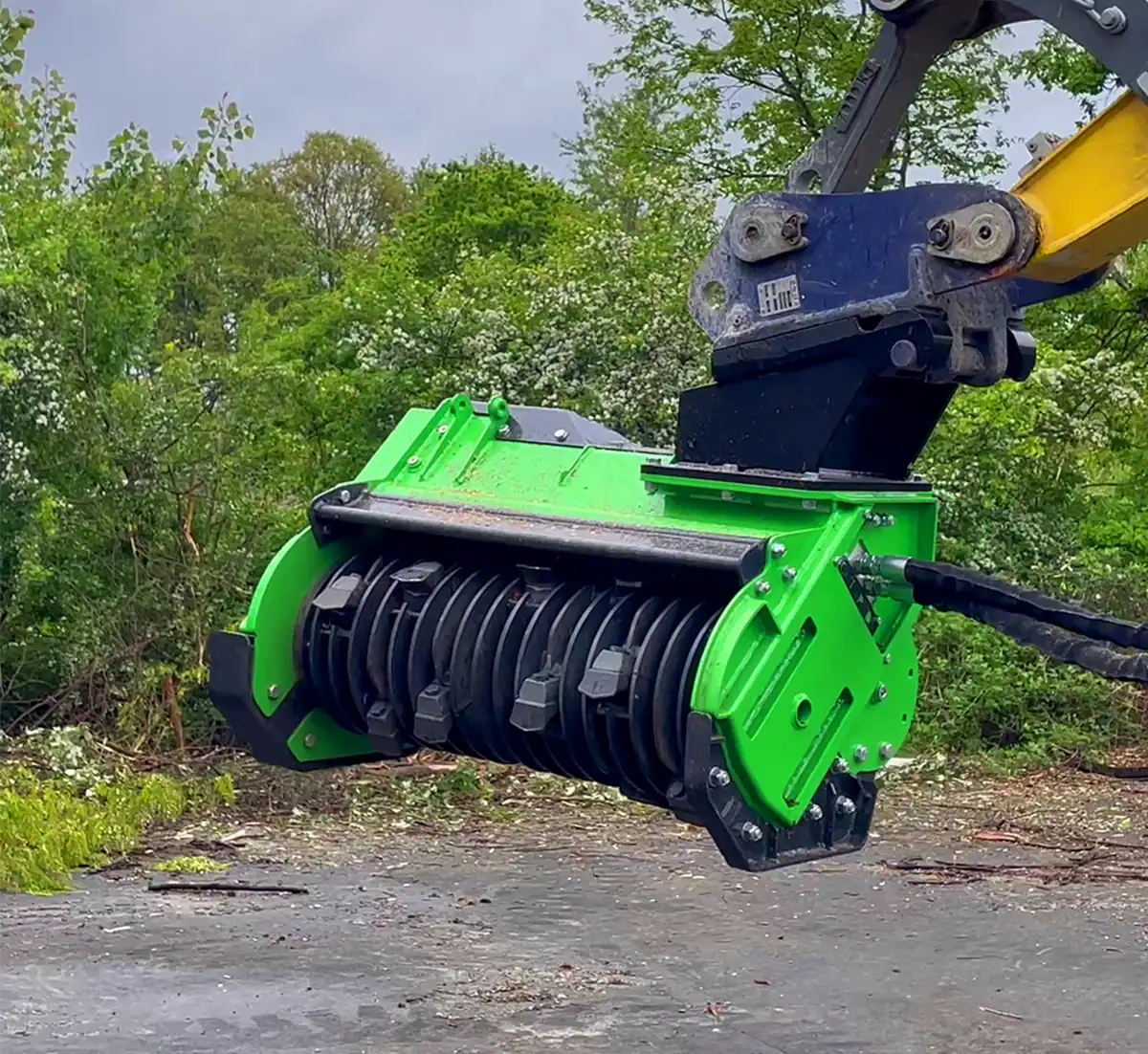
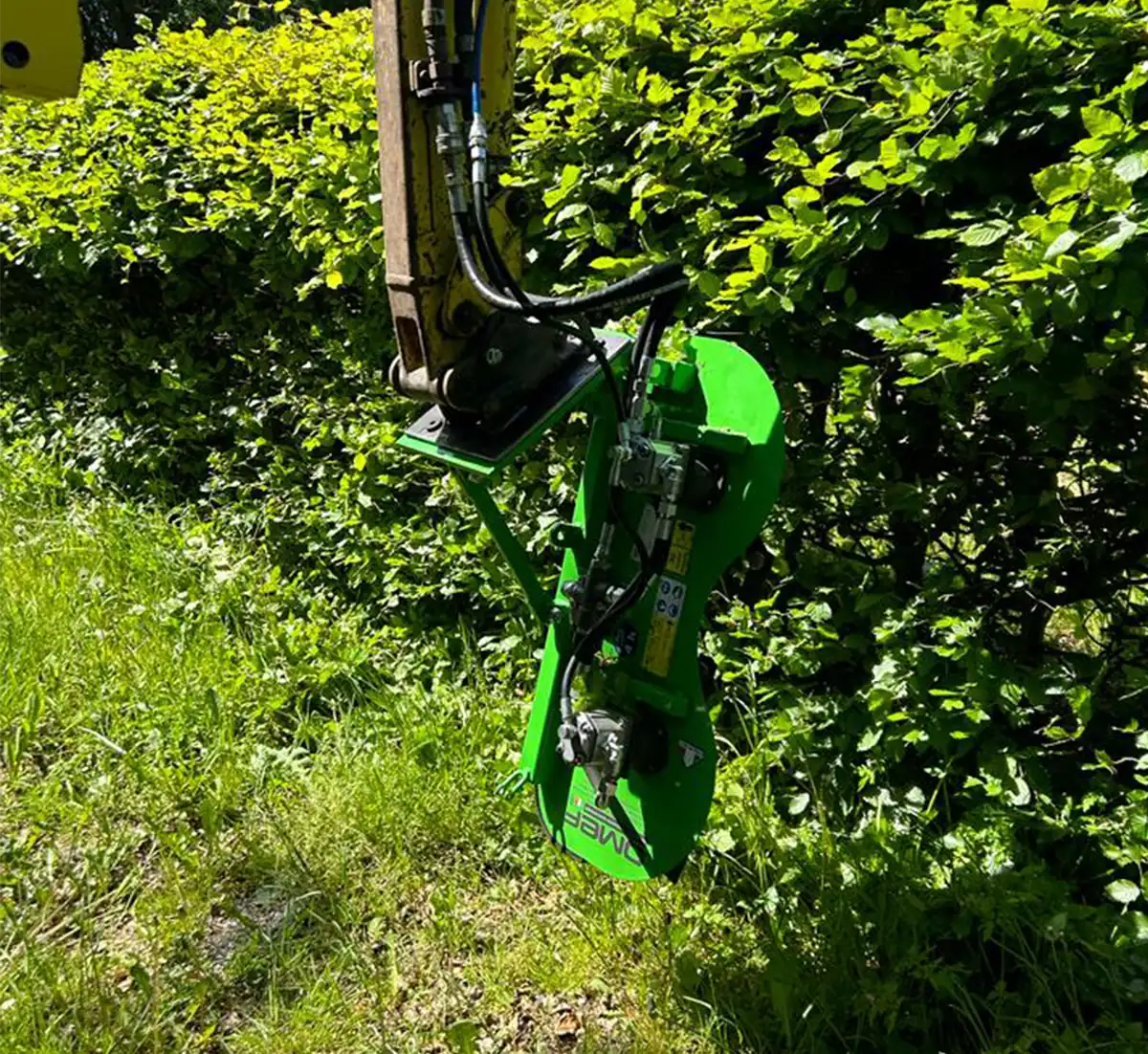
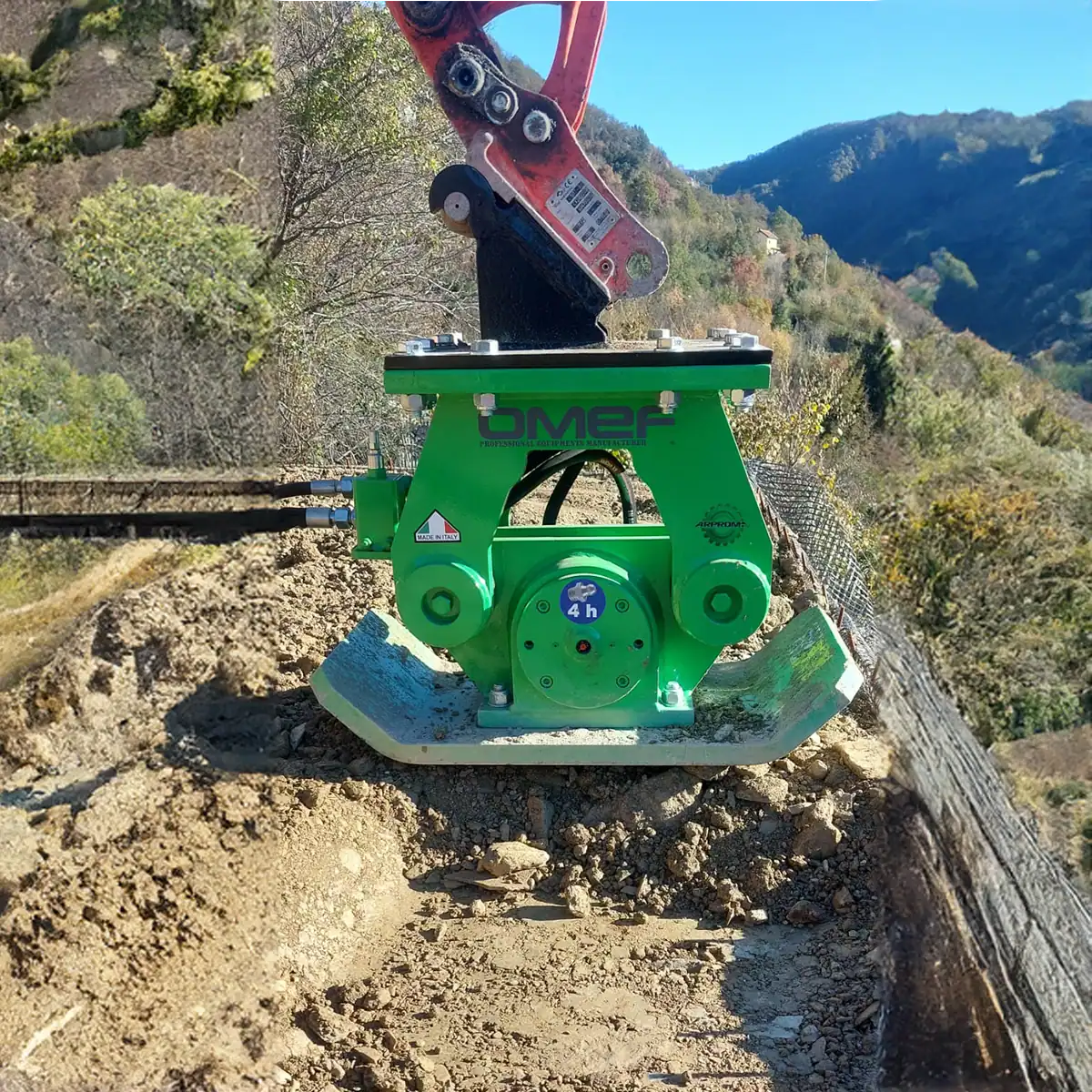
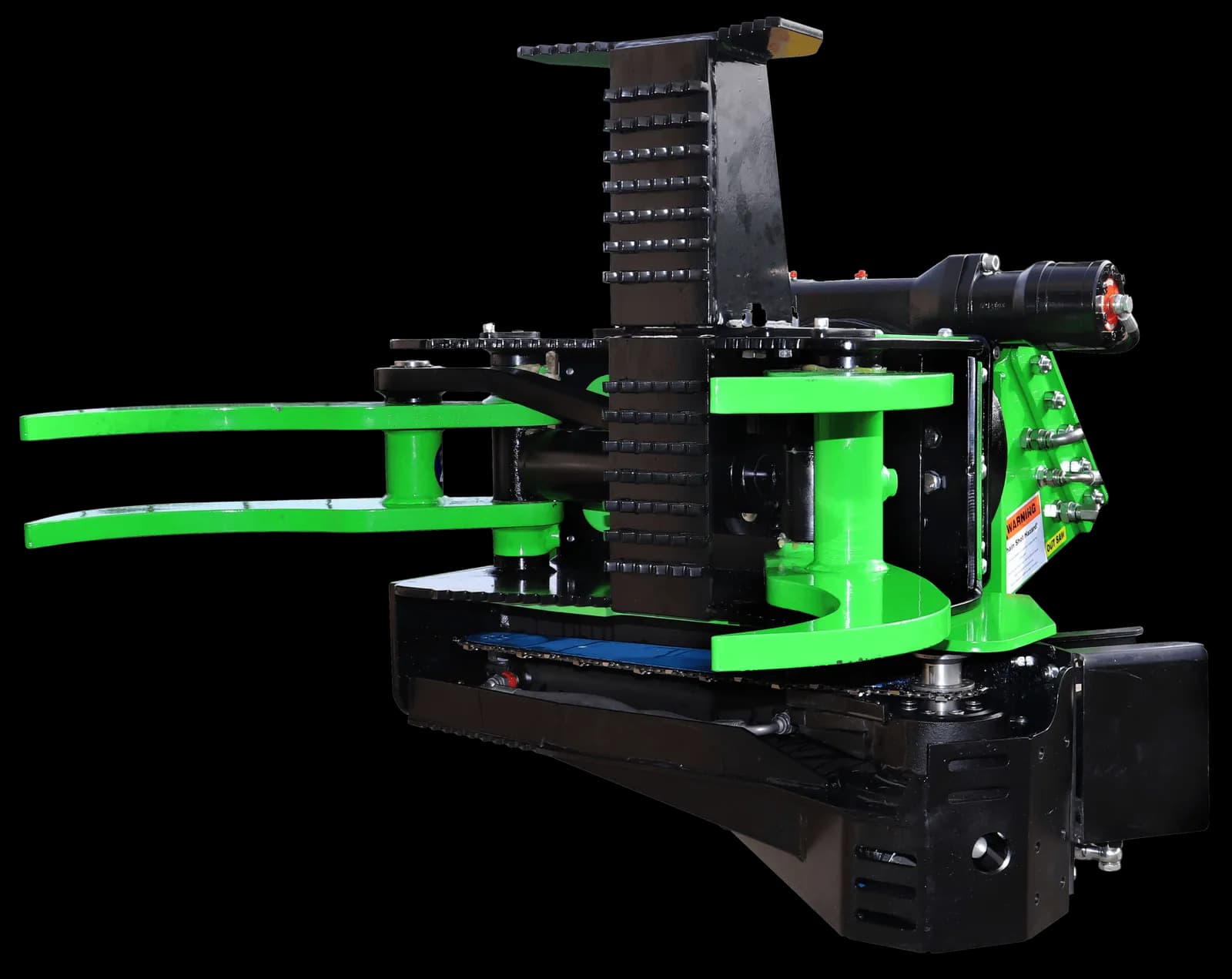
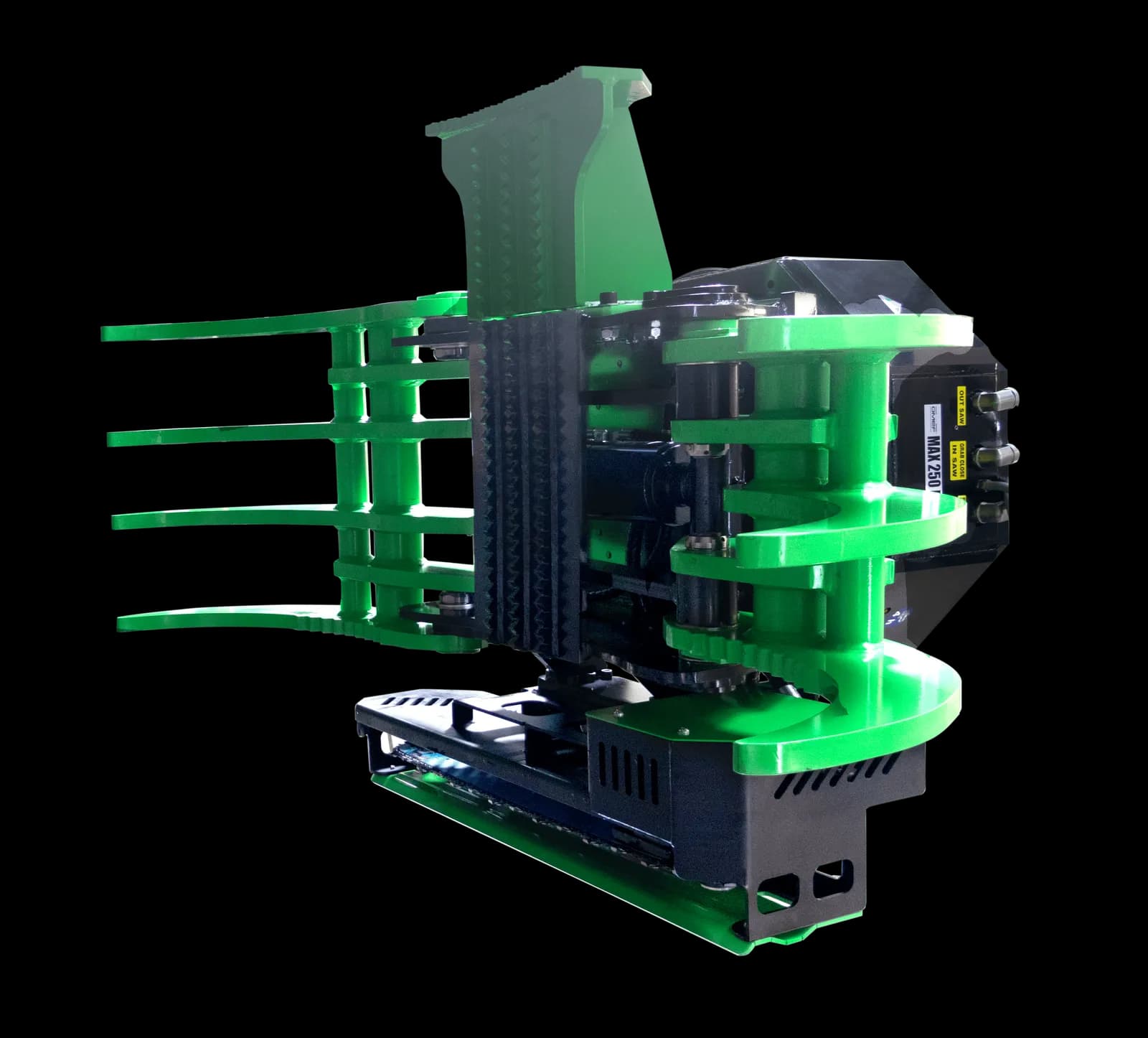
The range, up close
Why a grapple saw needs two circuits
Single-acting
Oil out, oil back, one direction
Mulchers, most trimmers
Hammer line + case drain
Third low-pressure line returns motor leakage to tank
Grinders, cutters, piston-motor tools
Double-acting
Powered both ways, so the tool opens and closes
Grabs, shears, pruners
Dual circuit
Saw line plus a separate grapple and rotation supply
Grapple saws
Frequently asked questions
01What is a grapple saw used for?
Cutting, gripping and handling trees or logs in one operation. It suits forestry site clearance, urban tree removal, pruning, cross-cutting oversized timber and managing windblown areas, because the section is held throughout the cut rather than dropped.
02What size excavator do I need?
The OMEF GS series covers 3 to 30 tonne machines across four models, with the smaller units also mounting on telescopic handlers. The Powerhand EX series saw suits excavators from 8 to 30 tonnes.
03What hydraulic setup does a grapple saw require?
The OMEF GS series uses a dual setup: a single-acting line for the chainsaw bar and a double-acting line through a solenoid valve for grapple movement and 360° rotation. The Powerhand unit requires only one hydraulic flow and return service.
04What chain do grapple saws use?
Harvester chain, typically .404" or 3/4" pitch depending on model. The Powerhand saw cassettes are available in both.
05Does a grapple saw rotate?
Yes. Both ranges offer 360° rotation. The Powerhand units use an Indexator GC124S rotator for swinging applications or an XR400 for rigid installations, both with internally routed hoses.
06Grapple saw or tree shear?
Shear for volume felling in open ground where speed is the goal. Grapple saw where control matters more than throughput, particularly near buildings, roads and services.
References
- 1Standards Australia / WorkSafe Victoria — AS 4772 — Earth-moving machinery quick hitchesQuick hitch safety system requirement
- 2International Organization for Standardization — ISO 8084 — Machinery for forestry, operator protective structuresOperator protective structures and guarding
Keep reading
This category is most often confused with 2 others: