What to take away
- 01This is the recurring-revenue category: utility and council vegetation programs are contracted, audited and renewed.
- 02Hydraulic demand varies by tool — the TRI bar runs a plain hammer line, the TG needs drainage, the CS needs two double-acting lines.
- 03Mechanised or not, the cut still has to comply with AS 4373 where the contract calls for it.
That single distinction is why mechanical pruning deserves more attention from contractors than it usually gets. A land clearing job ends and you go and find another one. A roadside vegetation contract, an orchard program, a utility line clearance panel or a council maintenance schedule comes back every year, on a cycle, with a budget already allocated.
Vegetation does not stop growing. That is the business model.
Where the demand comes from in Australia
Three recurring buyers dominate.
Electricity network operators. Distribution businesses run continuous, regulated vegetation programs to maintain clearances and reduce bushfire ignition risk. These are audited and contracted, and compliance is specified. Trimming is generally carried out to meet Australian Standard AS 43731, which can require branches be cut back to growth points. That is a technical specification, not a preference, and it constrains which tools are acceptable.
Councils and road authorities. Sight lines, clearance envelopes, footpath access, fire trail maintenance. Scheduled, budgeted, tendered.
Agriculture. Orchards, vineyards, windbreaks, shelter belts. Seasonal and repeating.
If you are trying to smooth out the lumpiness of project-based clearing work, this is the category that does it.
Five tools, and they are not interchangeable
Machinery Specialist supplies a range covering excavators, loaders and backhoes. The differences matter.
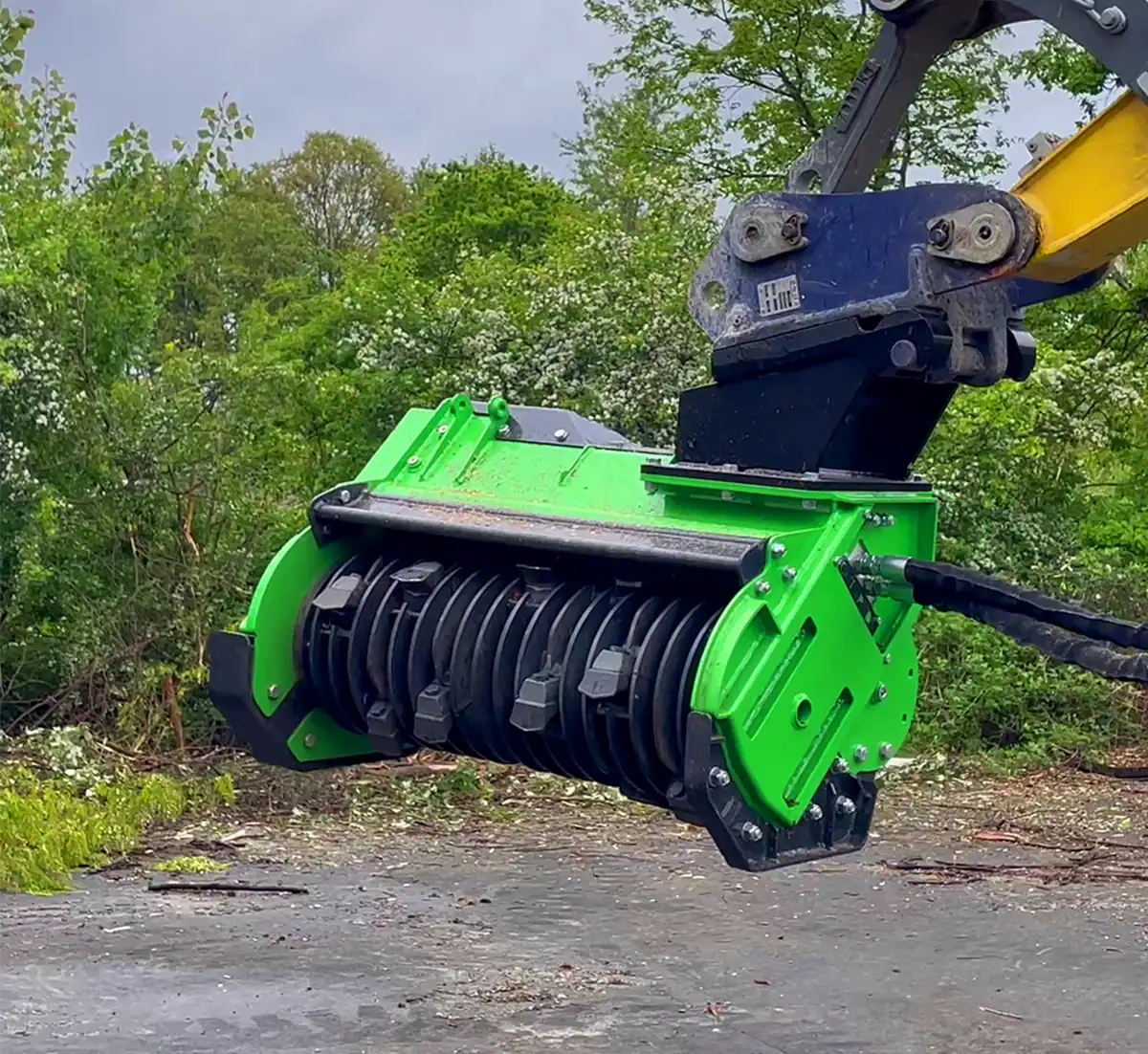
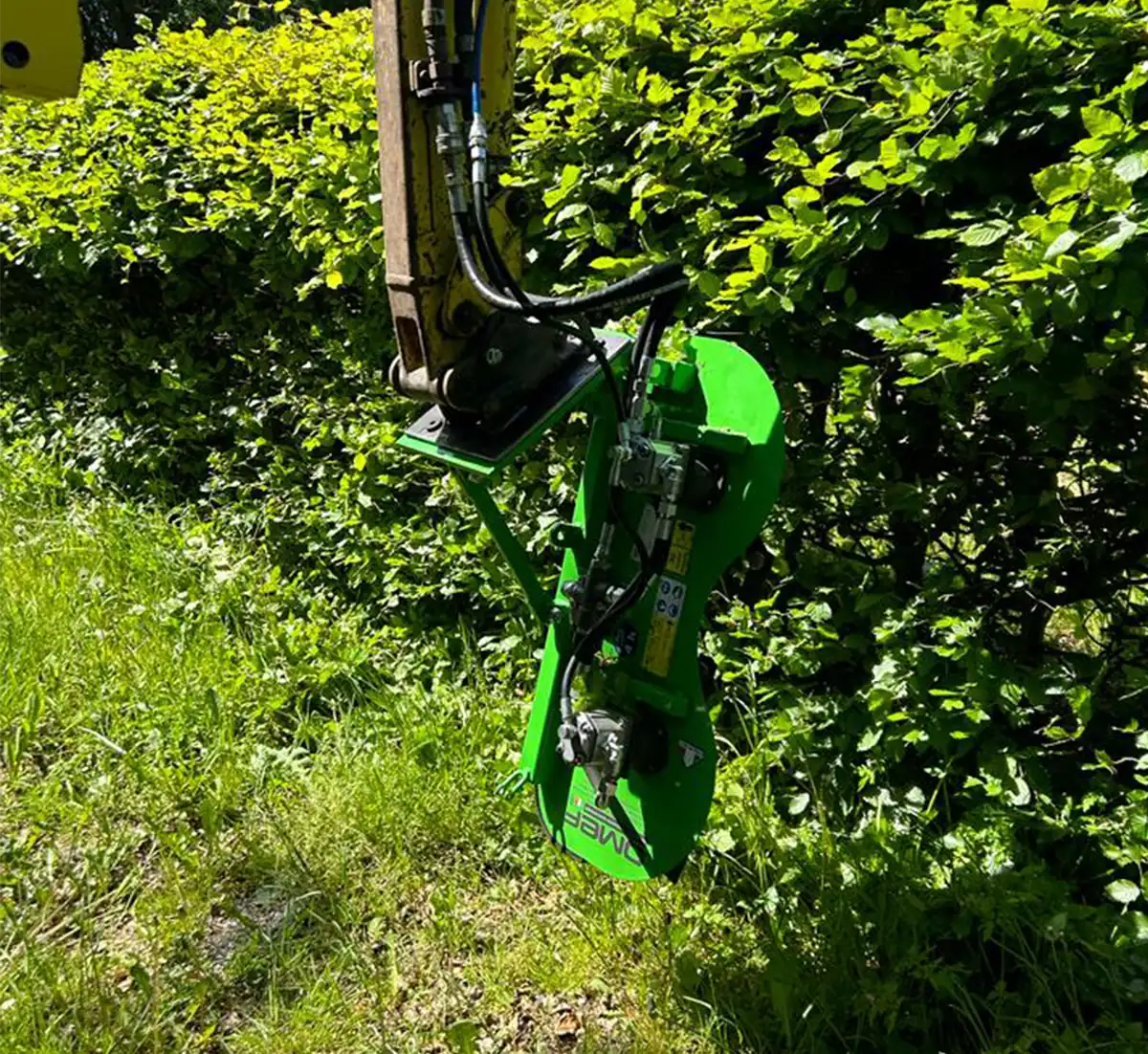
Hydraulic Hedge Trimmer, TG Series
| Parameter | Detail |
|---|---|
| Models | 2 |
| Cutting blades | Six or nine |
| Cutting system | Star-arranged knives in wear-resistant steel, high rotation speed |
| Result | Smooth even cut, finely shredded branches and foliage, significantly reduced debris |
| Hydraulics | Hammer line plus a drainage line |
| Mounts on | Excavators, backhoe loaders |
| Safety | Rubber guards around the cutting area |
| Supply | Turnkey kit with machine-specific bracket and hose kit |
The commercial angle is the debris reduction. On urban and roadside work, clean-up is often a larger cost than cutting. A system that shreds as it cuts reduces the second crew.
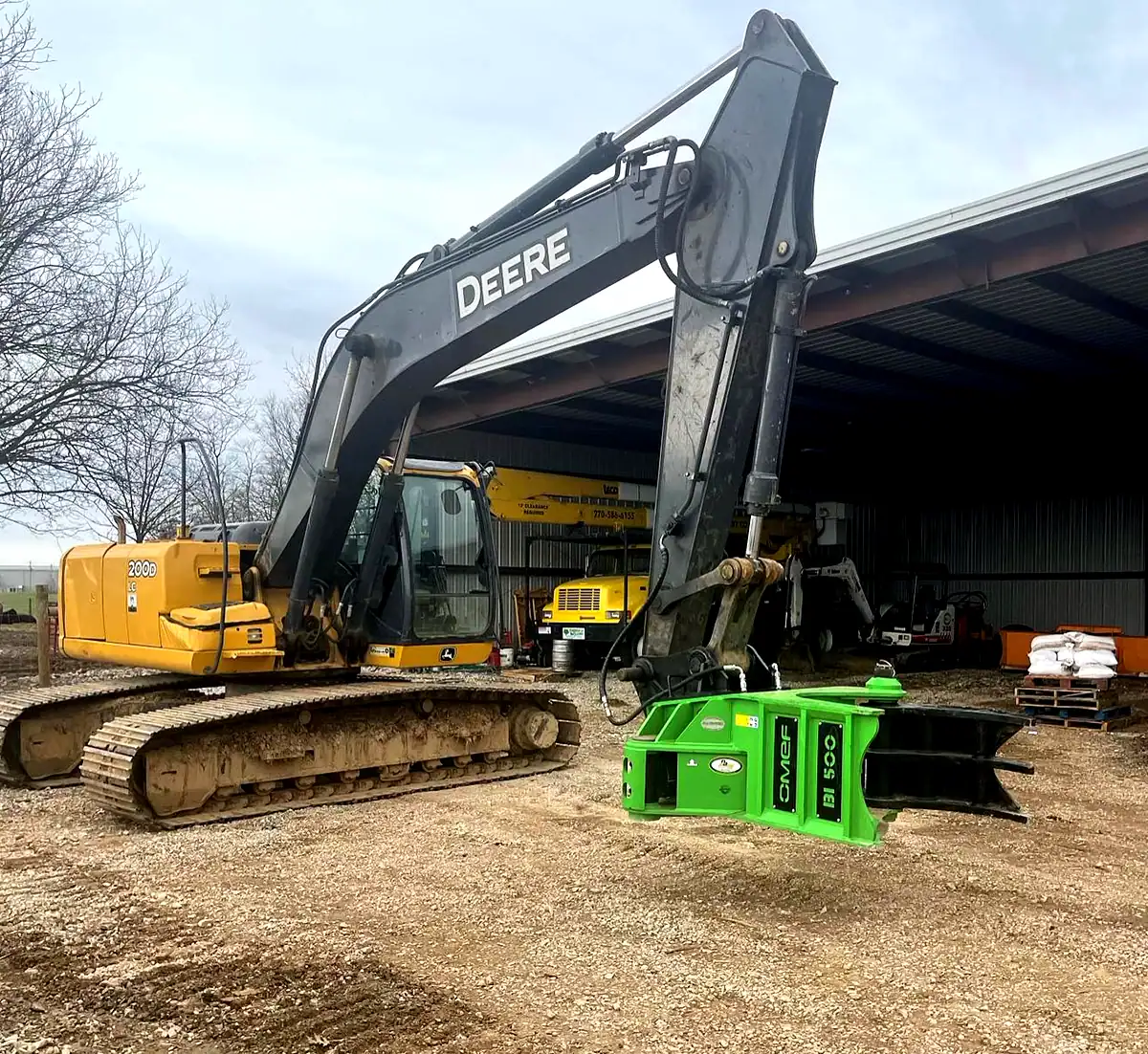
Pruning Cutting Bar, TRI Series
| Parameter | Detail |
|---|---|
| Models | 3 |
| Working length | 160 cm to 220 cm |
| Cutting system | Comb-shaped blades in a shearing motion, thrust piston with 3/4" flow control valve |
| Capacity | Pruning of tall trees up to around 100 mm diameter |
| Adjustment | Mechanical cutting angle adjustment |
| Hydraulics | Hammer line only, no drainage line required |
| Construction | High-strength wear-resistant steel structure and blades |
| Safety | CE-compliant guards |
Note the hydraulic requirement. No drainage line is a genuine practical advantage: simpler installation, fewer failure points, and it will run on more machines without modification. If your fleet is mixed and older, this matters.
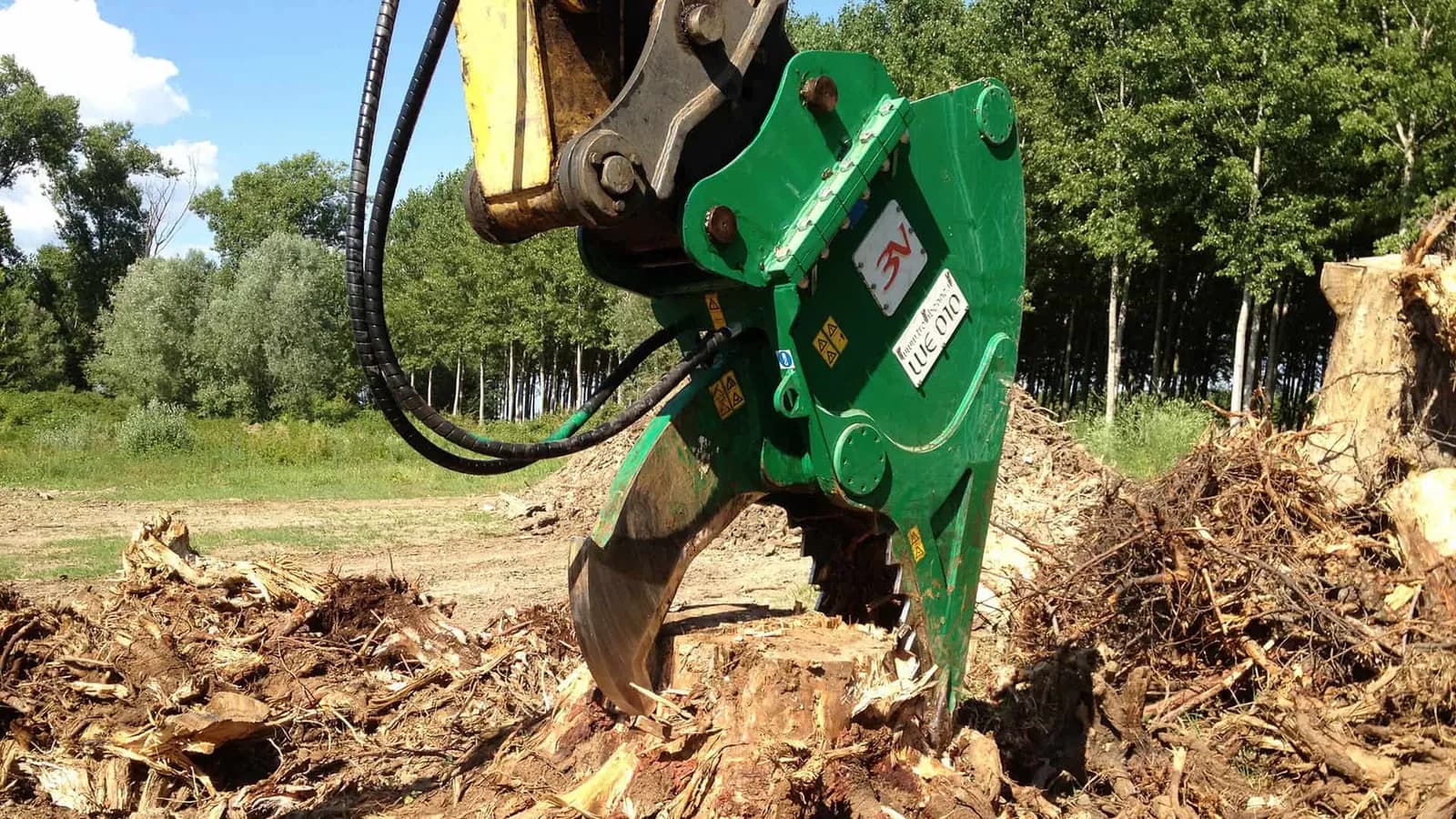
Disc Hedge Trimmer
Rotating steel discs providing smooth continuous cuts, suited to large hedges, orchards and roadside vegetation management, with forestry pruning capacity up to around 150 mm diameter. The fastest of the trimming options on volume hedge work.
Cutter Bar
Lightweight, for trimming hedges and small branches in landscaping and maintenance work. The light-duty end of the range.
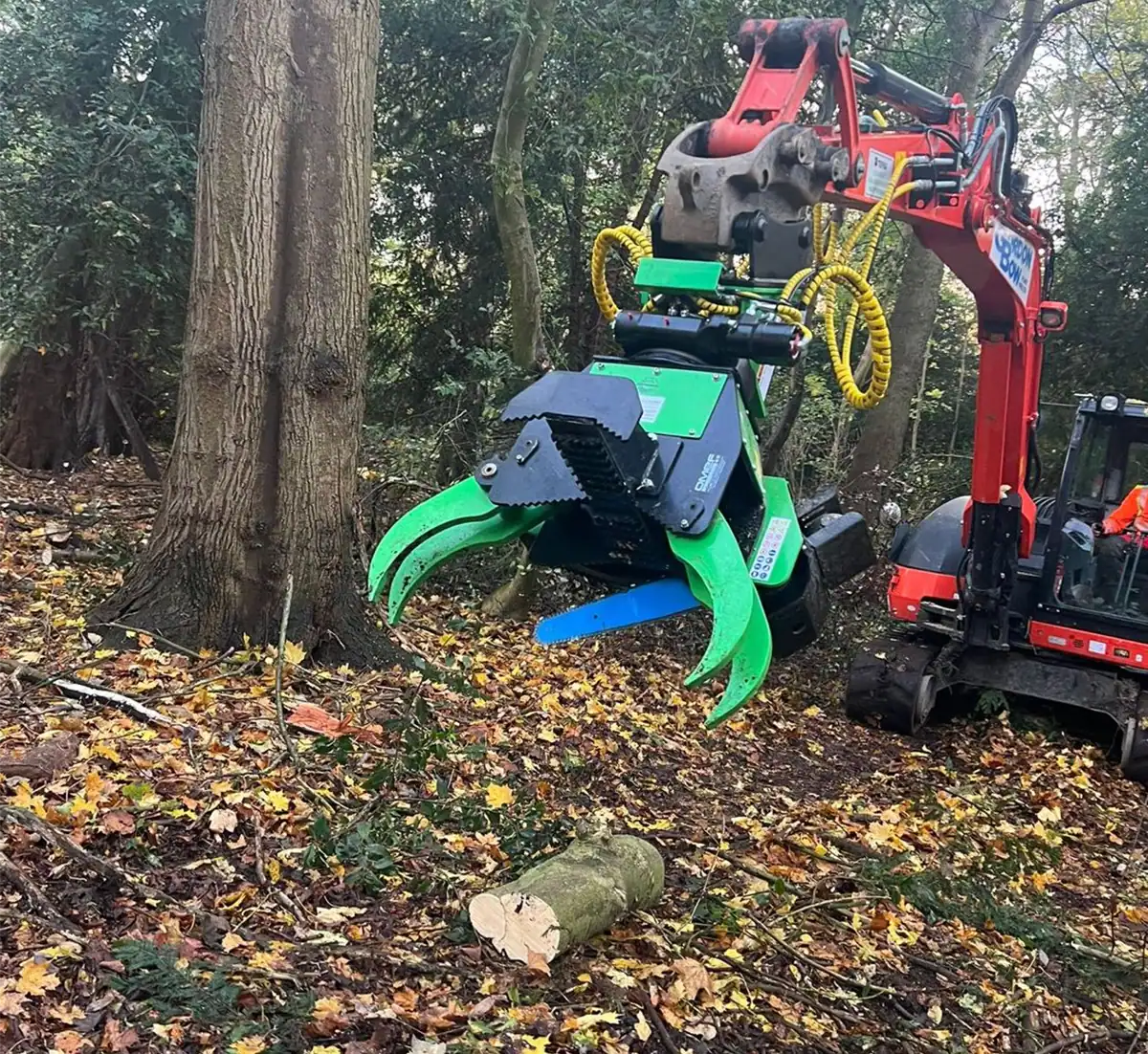
Forestry Pruner, CS Series
| Parameter | Detail |
|---|---|
| Models | 5 |
| Cutting capacity | 100 mm to 420 mm |
| Design | Lightweight, no holding grapple |
| Rotation | 360° |
| Hydraulics | Two double-acting lines |
| Mounts on | Excavators, skid steers, backhoe loaders, telescopic handlers |
| Construction | High-strength wear-resistant steel |
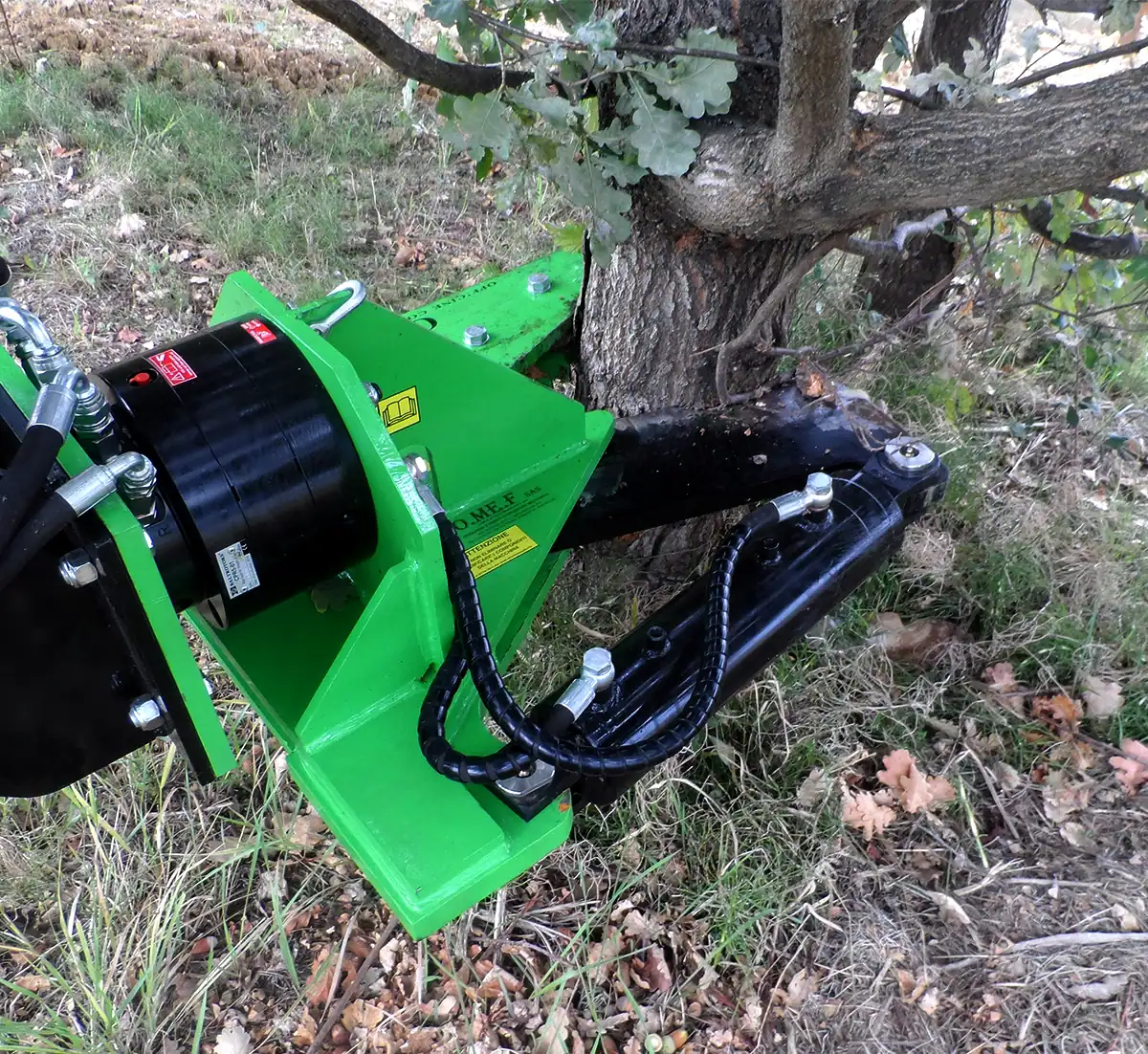
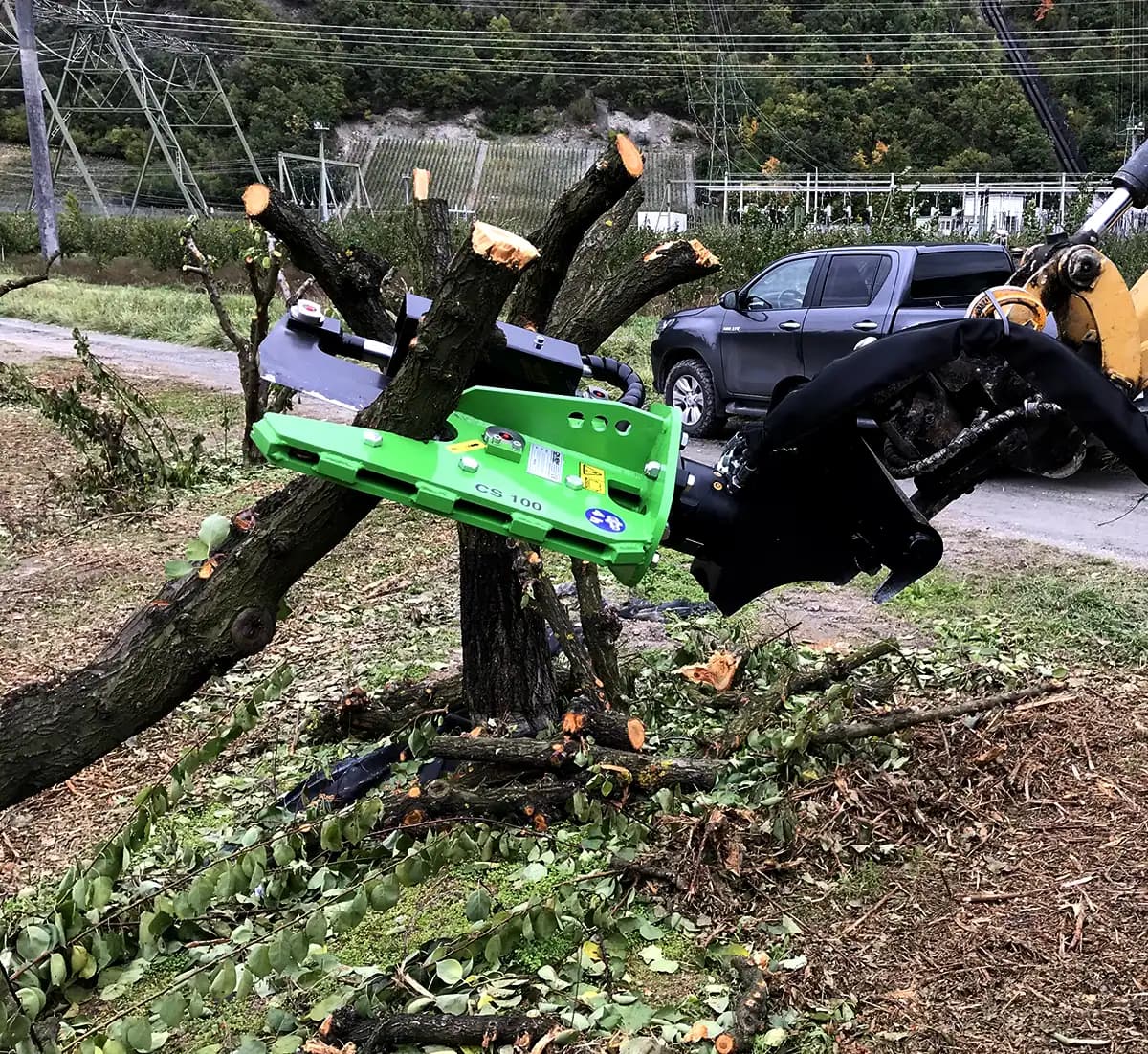
This is the heaviest tool in the pruning range and the one that overlaps with felling. The absence of a holding grapple is a deliberate trade: better manoeuvrability and precision in dense or elevated positions, at the cost of not controlling the cut section. Pair that with the fact that it rotates 360°, and it is a tool for reaching into awkward places quickly.
If you need the cut section held, that is a grapple saw, not a pruner.
Specifications are supplier-published and subject to change.
Choosing between them
| If the work is | Choose |
|---|---|
| Volume hedge and roadside trimming, clean finish, minimal debris | TG hydraulic hedge trimmer |
| Tall tree pruning to around 100 mm, simple hydraulics | TRI pruning cutting bar |
| Large hedges, orchards, up to around 150 mm | Disc hedge trimmer |
| Light landscaping maintenance | Cutter bar |
| Branches and small trees up to 420 mm, awkward access | CS forestry pruner |
The commercial case
Predictable revenue. Cyclical contracts let you forecast machine hours, which lets you finance equipment with confidence. This is the single biggest argument in the category.
Labour substitution with a compliance benefit. Manual pruning at height involves elevated work platforms, climbers, or both. Mechanised pruning from the ground is faster and changes the risk profile, which increasingly matters at tender stage.
Reduced clean-up cost. Shredding systems cut the second-pass cost. On roadside work under traffic control, that is where margin actually lives.
Consistency. Machines produce repeatable cut quality across a long run, which matters when the contract specifies an outcome and an auditor checks it.
The honest limitations
- AS 4373 compliance is your responsibility, not the tool's. A machine can produce a non-compliant cut. Confirm the tool suits the specification before quoting utility or council work.
- Mechanical pruning is not arboriculturally appropriate everywhere. Heritage trees, significant trees and specimen plantings generally require hand pruning. Do not tender mechanised pruning for work that specifies otherwise.
- Drainage line requirements vary by tool. The TG needs one. The TRI does not. Check before you assume the tool will fit your machine.
- Capacity limits are firm. Feeding a 200 mm branch into a tool rated for 100 mm damages the tool and produces a torn cut that will fail inspection.
- Finish quality varies by system. Star-knife shredding, comb-blade shearing and rotating discs all leave different results. Match the system to what the contract specifies.
Buy, hire or subcontract
| Situation | Route |
|---|---|
| One-off trimming job | Subcontract |
| Tendering for a council or roadside maintenance contract | Buy. You cannot win recurring work on hired plant pricing. |
| Seasonal orchard work | Buy if you can stack multiple clients into the season |
| Utility line clearance panel | Buy, and confirm tools meet the specified standard first |
Compliance notes
AS 4373, the Australian Standard for pruning of amenity trees, is the document that most often governs this work and is routinely written into contracts. Where the work is near powerlines, additional network-specific requirements apply, including operator training and qualification requirements set by the network operator.
Quick hitches must meet AS 4772-20082 or an equivalent such as ISO 13031-2016 with a secondary retention system. Guarding supplied with the attachment, including the rubber guards on the TG series and the CE-compliant guards on the TRI series, is part of the safe system of work.
Questions to ask before you sign
- Does this tool produce a cut that meets AS 4373 for the work I am tendering?
- Does it need a drainage line, and does my machine have one?
- What is the maximum branch diameter, and what happens if operators exceed it?
- How much debris does it leave, and does that change my clean-up crew?
- What is Australian availability on blades and knives?
- Does the price include the machine-specific bracket and hose kit?
In the field
Frequently asked questions
01What is a hydraulic hedge trimmer for excavators used for?
Precise hedge trimming and vegetation control in landscaping, roadside maintenance and green area management. The TG series uses rapidly rotating star-shaped knives in wear-resistant steel to give a clean, even finish with minimal residue.
02What is a pruning cutting bar used for?
Pruning branches and shrubs with clean, controlled cuts in forestry, agriculture and vegetation maintenance. The TRI series uses comb-shaped blades driven by a thrust piston, with working lengths from 160 cm to 220 cm.
03What is a forestry pruner used for?
Precise pruning and controlled cutting of branches and vegetation. The CS series covers cutting capacities from 100 mm to 420 mm across five models, with 360° rotation and a lightweight design that omits a holding grapple for better manoeuvrability.
04What machines can mechanical pruning attachments mount on?
Depending on the tool, excavators, backhoe loaders, skid steers and telescopic handlers, using a machine-specific bracket and hose kit.
05Do these attachments need complex hydraulics?
It varies. The TRI pruning cutting bar runs on a standard hammer line with no drainage line. The TG hedge trimmer needs a hammer line plus drainage. The CS forestry pruner uses two double-acting lines.
References
- 1Standards Australia — AS 4373 — Pruning of amenity treesPruning specification written into council and utility contracts
- 2Standards Australia / WorkSafe Victoria — AS 4772 — Earth-moving machinery quick hitchesQuick hitch safety system requirement