What to take away
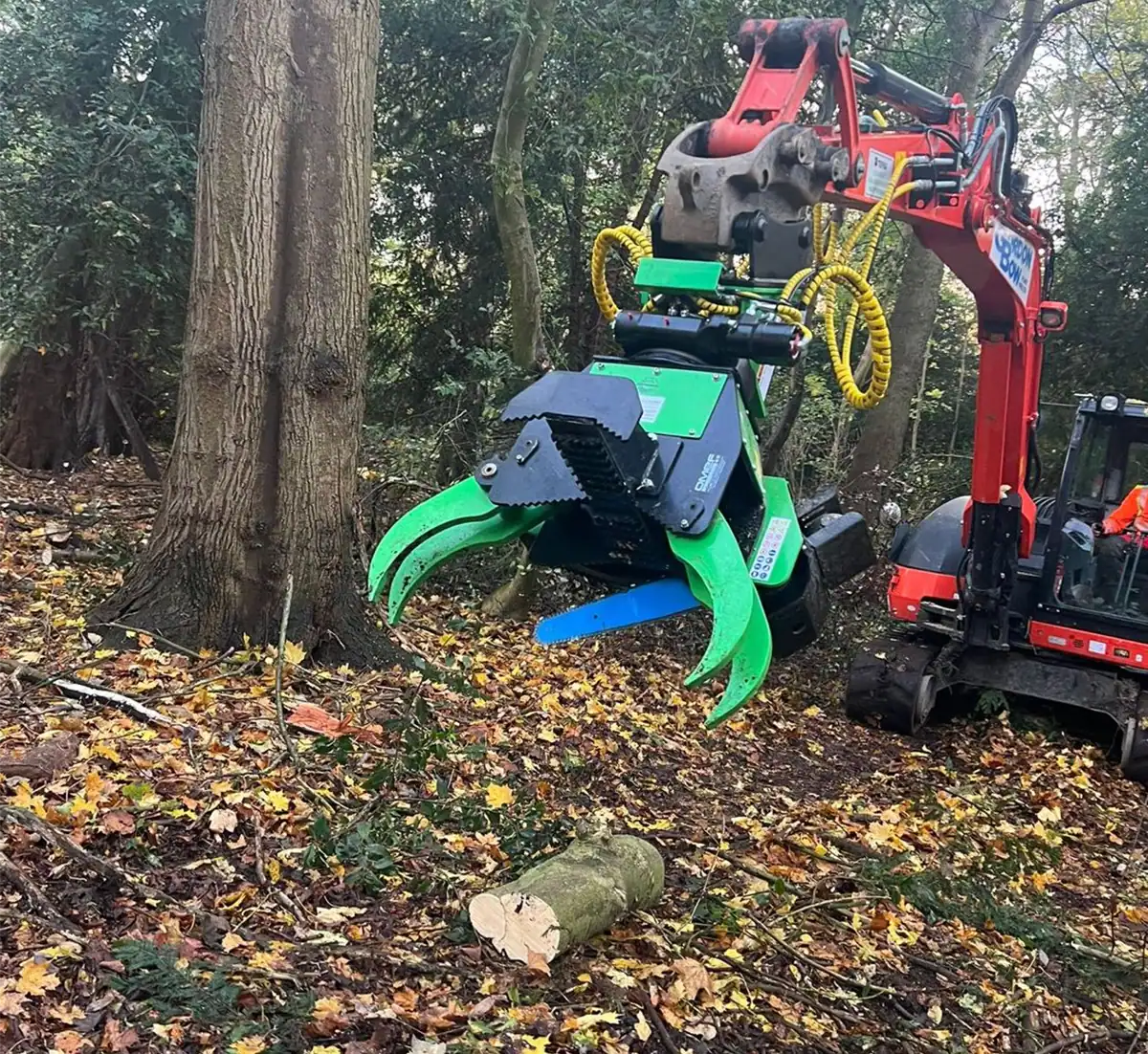
- 01A shear grips, cuts and keeps holding in one motion — a chainsaw drops a tree where gravity decides, a shear puts it where the operator wants it.
- 02Published maximum trunk widths are best-case figures. Derate them for dense, fibrous or buttressed Australian hardwood.
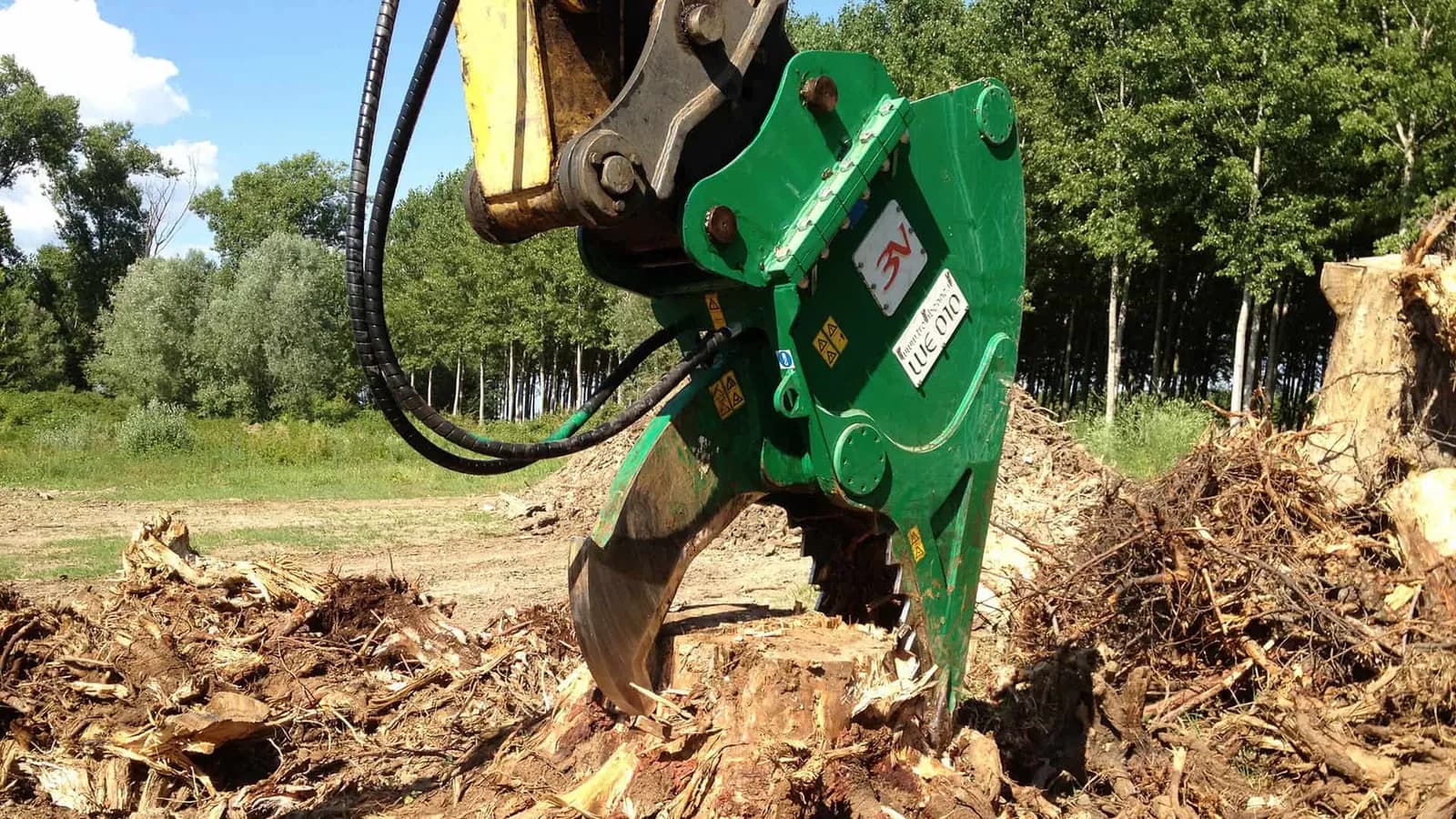
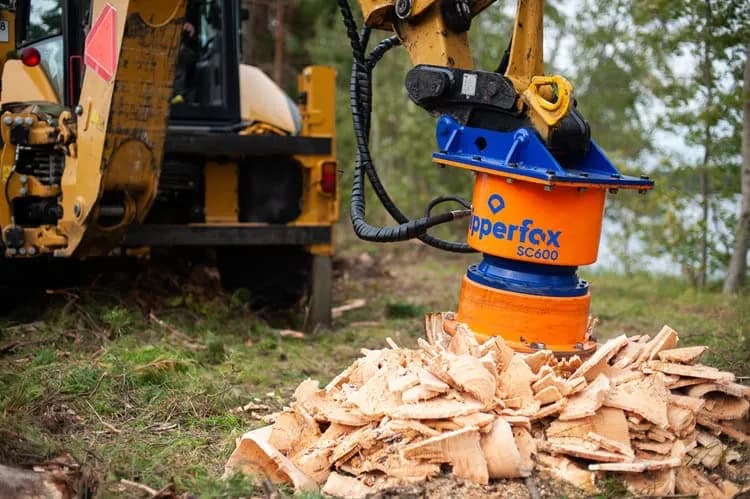
- 03It does not touch the stump. Stump removal is a grinder or cutter job, and they are different tools doing different work.
If your work involves volume felling, thinning, or taking down stems near something expensive, this is the category to understand first.
What a shear actually replaces
Understand what you are displacing before you price anything.
A chainsaw crew. A shear does not make a faller redundant on complex removals. It makes them redundant on repetitive ones. Straight stems under about 400 mm, in accessible ground, in quantity, are exactly where a crew is slow and a shear is fast.
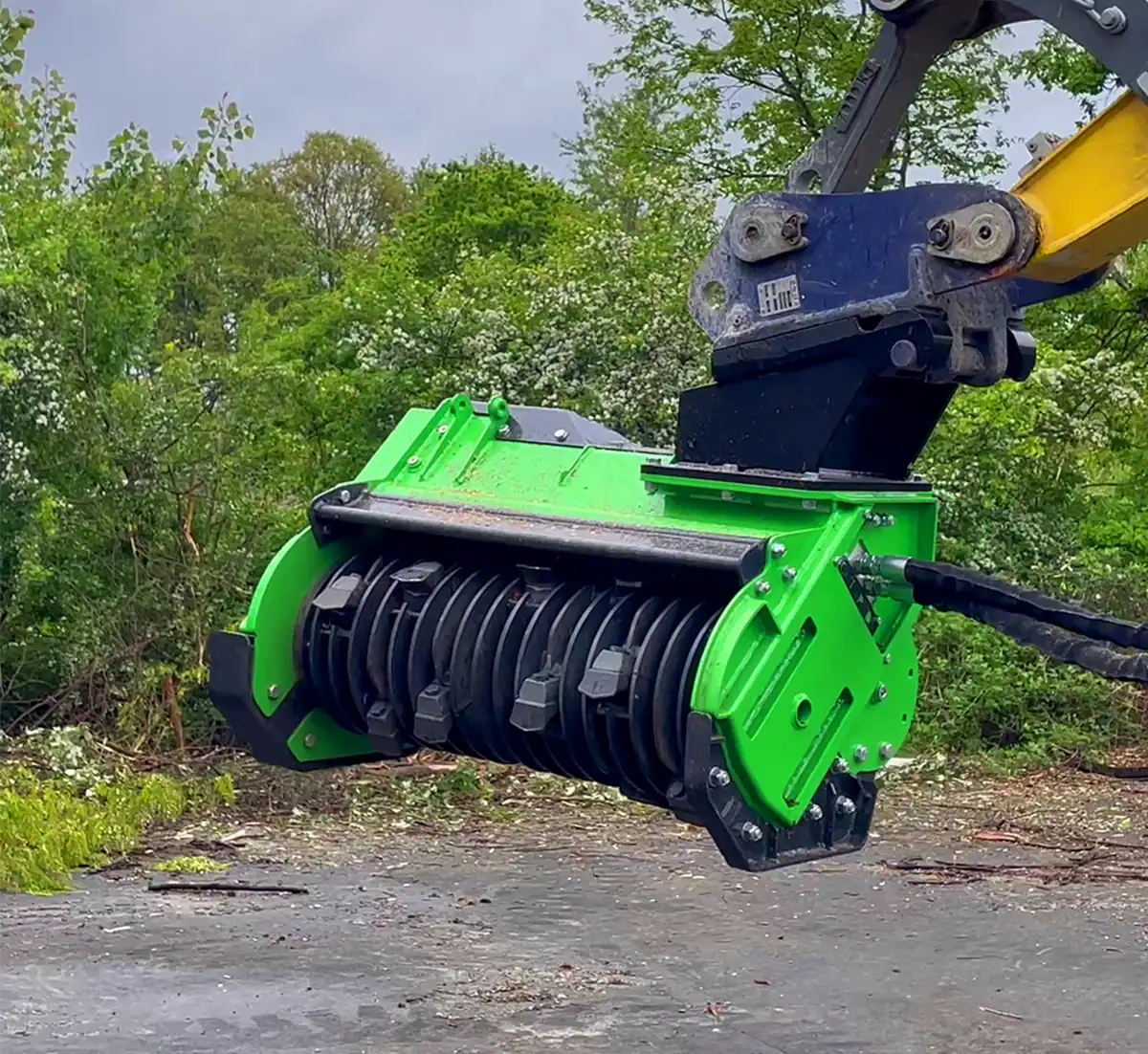
A mulcher, sometimes. Both clear vegetation. A mulcher destroys the material. A shear preserves it. If the timber has value as firewood, biomass, chip or millable log, shearing keeps that value and mulching burns it. If the material is worthless scrub, the mulcher is the better tool and the shear is a slower way to get there.
An elevated work platform. Grip-and-hold changes the risk profile near powerlines, buildings and roads. You are not lowering a cut section with rope and a groundie. You are carrying it.
The commercial case, stated plainly
Three revenue arguments hold up.
Throughput on repetitive felling. Grab, cut, carry, stack. No walking, no wedging, no re-assessing lean per tree. On plantation thinning and roadside removal this is where the productivity gap is widest.
Fewer people in the hazard zone. This shows up in your insurance conversation, your safety case for tender submissions, and your ability to work in places a ground crew cannot be signed off to work.
Directional control near assets. Work you previously priced as too risky becomes work you can quote. That is category expansion, not just efficiency, and it is usually the argument that actually justifies the purchase.
The argument that does not hold up: a shear is not a cheap way to deal with occasional trees. If you fell fewer than a few hundred stems a year, you are buying convenience, not economics. Be honest about which one you are buying.
Matching a shear to your carrier
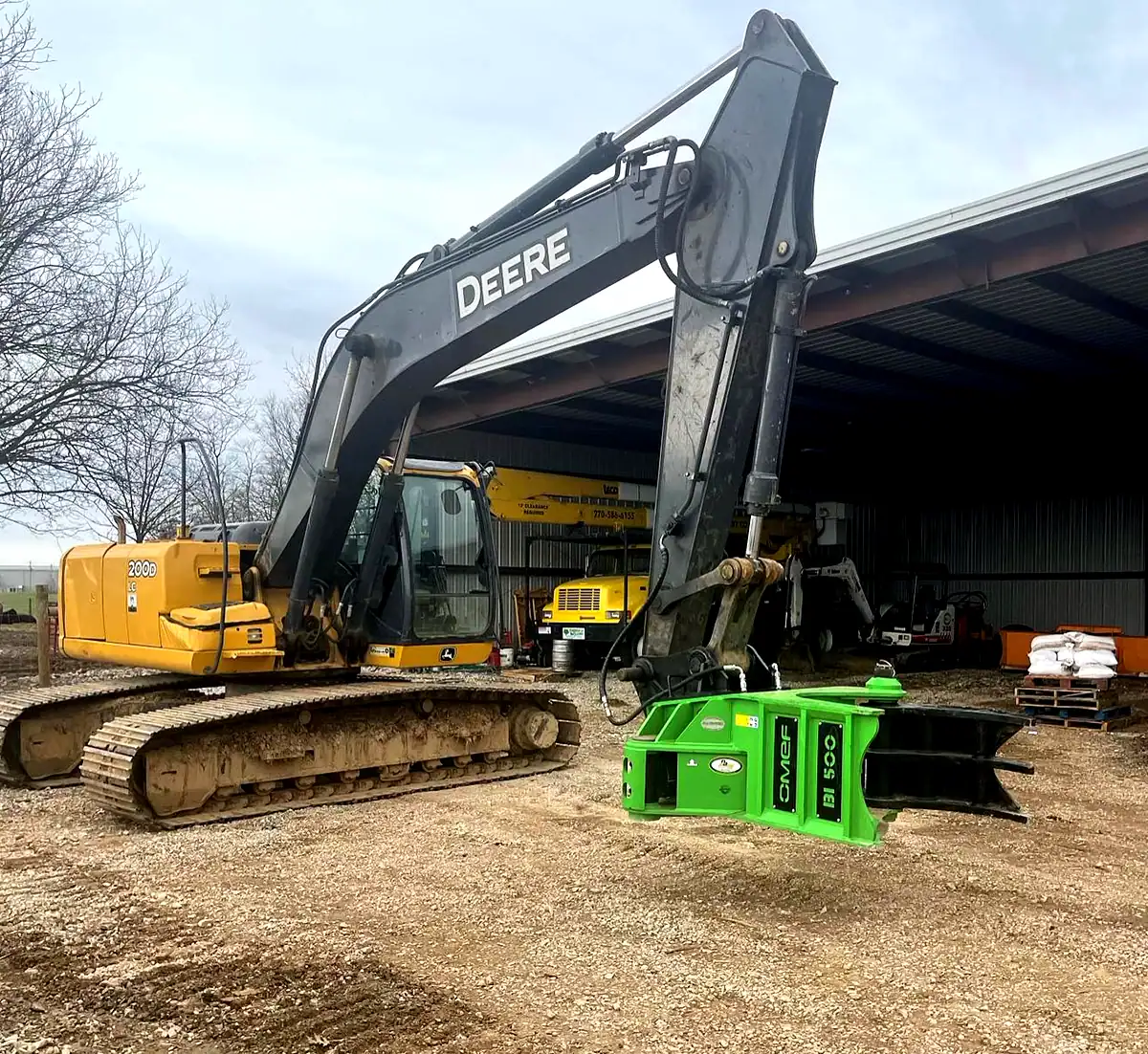
Machinery Specialist supplies the OMEF BIG INCH (BI) series, an Italian-built range designed to grab, cut and hold in a single motion.
| Parameter | BIG INCH BI series range |
|---|---|
| Models available | 6 |
| Unit weight | 140 kg to 2,400 kg |
| Carrier range | 2 t to 50 t excavators |
| Cutting capacity | 40 mm to 600/700 mm trunk width |
| Blade | Integrated, patented profile |
| Steel | XAR wear-resistant plate |
| Options | Rotation, central clamp |
Specifications are supplier-published and subject to change. Confirm against the current model sheet before purchase.
Three sizing rules worth following:
Size to your largest routine stem, not your largest possible stem. Buying two classes up so you can handle the occasional monster means you carry the weight penalty every day for the exception. Subcontract the exception.
Weight matters more than you think on small carriers. A 2 to 6 tonne machine feels a heavy head at full reach immediately. Check the attachment weight against your machine's lift chart at the working radius you actually operate at, not at the boom-tucked figure.
Decide on rotation early. Rotation is what converts a shear from a felling tool into a felling-and-placing tool. If you intend to stack, load or feed a chipper, you want it. Retrofitting is rarely economic.
Running cost: where the money actually goes
Blade condition. The consumable that decides your cut quality. A dull or chipped blade crushes instead of shearing, which slows the cycle, loads the cylinder and produces a ragged stump. Blade maintenance is a scheduled job, not a reactive one.
Cylinder and pin wear. The shear does its work through one high-force cylinder. Pin and bush wear is normal, and ignoring it lets the jaw track out of line, which is how blades get destroyed.
Structure. XAR-class steel is used because operators use shears as pushing and levering tools even when told not to. Assume some of that will happen and specify accordingly.
Carrier hydraulics. Shears are double-acting and intermittent, which is gentle by forestry standards. This is one of the few categories that will not punish a standard excavator circuit.
The honest limitations
Say these out loud before you buy, because a supplier who does not raise them is not your friend.
- Stump quality. A shear leaves a stump. Often a rough, split one. If your scope requires a clean flush cut or full stump removal, you are buying a stump grinder as well.
- Species behaviour. Stringy, fibrous and heavily buttressed Australian hardwoods do not shear like plantation pine. Cutting capacity figures are published against favourable timber. Ask for footage in your species before you commit.
- Splitting and barber-chairing. Large stems under tension can split up the trunk during the cut. That is a real hazard, not a marketing footnote, and it is a reason to train operators rather than assume the tool removes all risk.
- Not a processor. A shear fells and holds. It does not delimb, and it does not cross-cut to length. If you need that, look at grapple saws.
Buy, hire or subcontract
| Annual felling volume | Recommended route |
|---|---|
| Occasional, under ~200 hours | Subcontract or hire |
| Seasonal, 200 to 500 hours | Buy if it unlocks work you currently decline |
| Continuous, 500 hours plus | Buy, and negotiate wear-part supply in the same deal |
Compliance notes
Quick hitches carrying a heavy shear must meet AS 4772-20081 or an equivalent such as ISO 13031-2016, including a secondary safety system so the attachment cannot unintentionally release if primary retention fails. Guarding matters too: felling puts stems and debris near the cab, and ISO 8084 covers operator protective structures for exactly this reason. Where the work is amenity or utility pruning rather than removal, AS 4373 governs the cut and you should confirm a shear produces a compliant result before quoting.
Questions to ask before you sign
- What is the cutting capacity in eucalypt, not in pine?
- Is the blade replaceable in the field, or is it a workshop job?
- What is the lead time on blades, pins, bushes and cylinder seals, held in Australia?
- Does the quoted price include a machine-specific mounting bracket and hose kit?
- Is rotation available on this model, and what does it do to the weight and the flow requirement?
- Can I see the attachment working in my species and my stem size?
Frequently asked questions
01What is a tree shear used for?
Felling and holding standing trees, thinning shrubs and bushes, and removing stems in forestry, road maintenance, land reclamation and environmental works. The defining feature is that it grips, cuts and holds in one motion.
02What size excavator do I need?
The OMEF BI series spans excavators from 2 to 50 tonnes across six models. The correct model is set by your routine stem diameter and your machine's lift capacity at working radius, not by the machine's weight alone.
03What is the biggest tree a shear can cut?
The BI range covers trunk widths from 40 mm up to 600 to 700 mm depending on model. Treat published maximums as best-case figures in favourable timber, and derate for dense, fibrous or buttressed hardwood.
04Tree shear or forestry mulcher?
Shear if the timber has value or has to be placed somewhere specific. Mulcher if the material is waste and you are clearing by area rather than by stem. Many contractors eventually own both.
05Does a tree shear remove the stump?
No. It leaves a cut stump in the ground. Stump removal requires a stump grinder or a stump cutter, which are different tools doing different jobs.
References
- 1Standards Australia / WorkSafe Victoria — AS 4772 — Earth-moving machinery quick hitchesQuick hitch safety system requirement
Keep reading
This category is most often confused with 2 others: