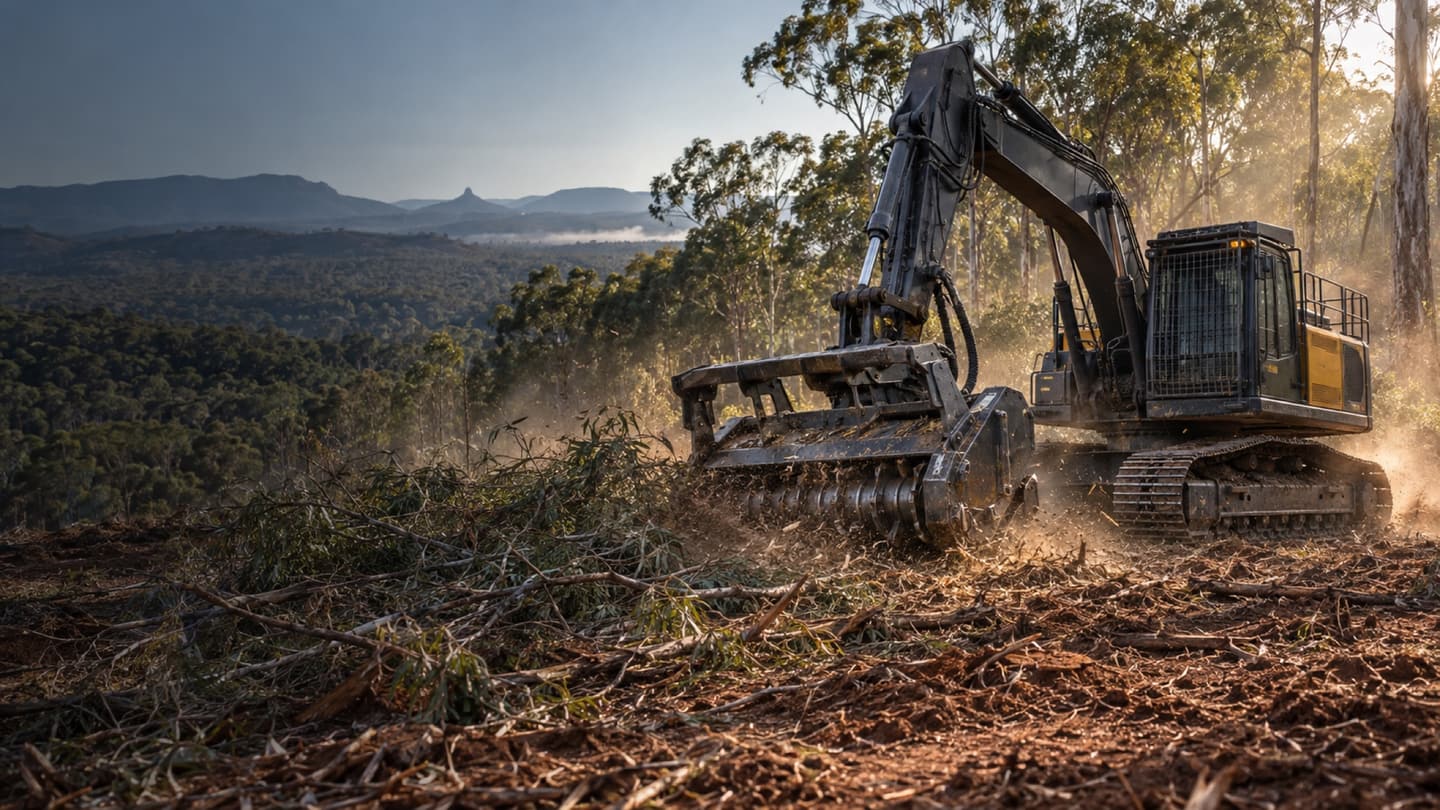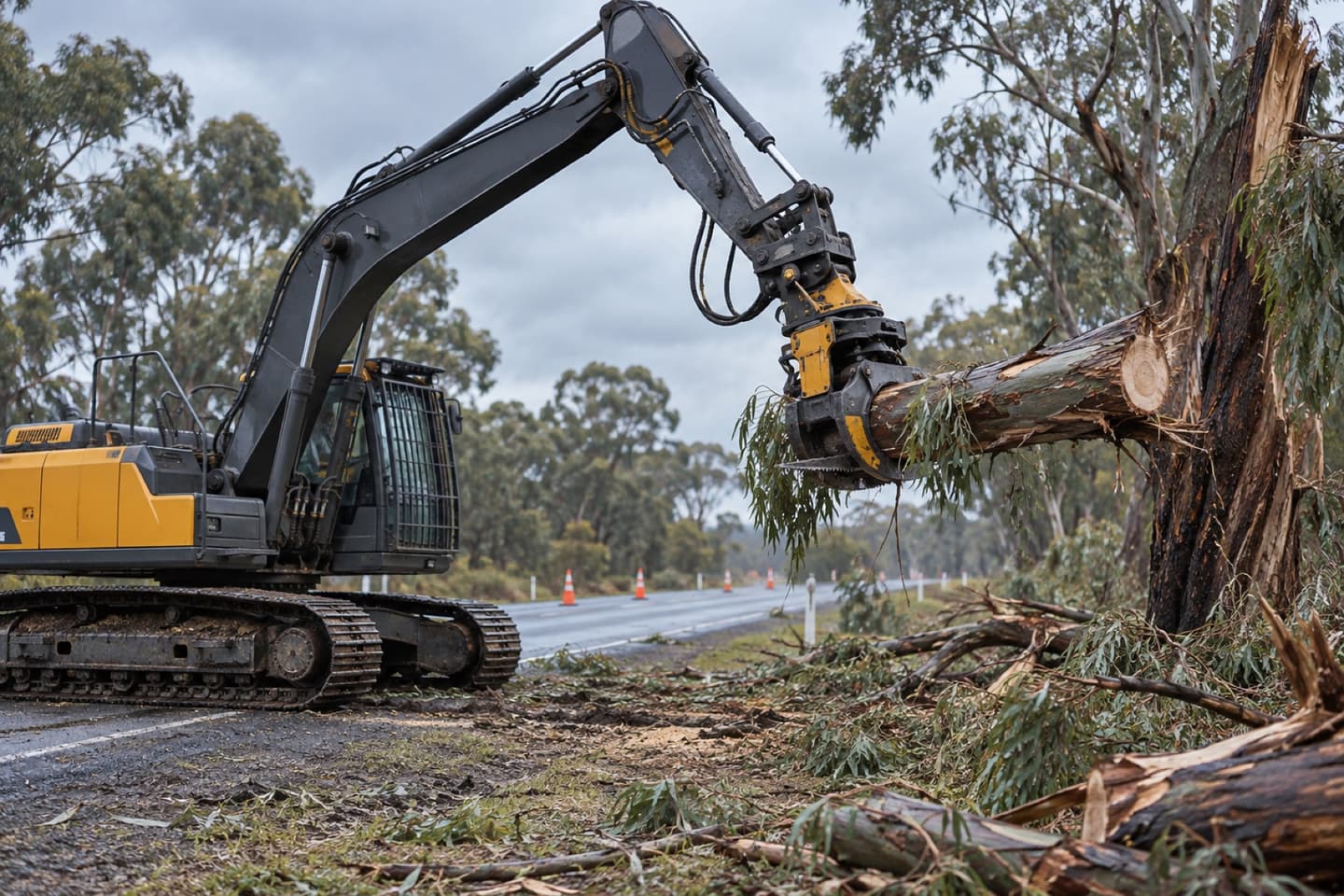
Road Corridor Clearing Equipment
How Australian road authorities and civil contractors mechanise verge, batter and widening clearances, and which excavator attachments earn their place when traffic control is the cost that dominates.
Every application guide sets out the typical work sequence, the attachment families and models that do the heavy lifting, the carrier classes that suit the work, the Australian site factors that change the choice, and how production is measured and priced.

The same attachment behaves like a different machine depending on the contract it is working under. A mulcher on a rail corridor is measured by what it achieves inside a possession window. The same head on a solar farm is measured by hectares before the panel crews arrive. On a council reserve it is measured by how little mess is left behind on a Monday morning. None of those is a specification problem, and all of them change which machine is the right buy.
These guides start from the work rather than the catalogue. Each one sets out how the job is usually contracted and priced, the attachment sequence it tends to follow, the carrier classes that suit it, and the Australian site factors that quietly decide production: hardwood density, terrain and access, traffic control or possessions, fire season, remoteness from parts, and the approvals that govern clearing native vegetation.
If you already know which family you want, the equipment guides go deeper on the machines themselves, and the frequently asked questions cover the compatibility and hydraulics questions that come up on every job regardless of sector.

How Australian road authorities and civil contractors mechanise verge, batter and widening clearances, and which excavator attachments earn their place when traffic control is the cost that dominates.

Why possession windows, not machine hourly rates, decide rail vegetation equipment, and how contractors match pruning bars, mulchers, shears and grapple saws to Australian rail corridors.

Distribution clearance pruning and transmission easement clearing are different jobs with different equipment; this guide matches mulchers, shears, grapple saws and pruning heads to each in Australian conditions.

Mechanical fuel reduction is a hectare-rate mulching business with a hard seasonal deadline; here is how contractors size Shearex mulchers, shears and grapples for Australian asset protection zones and firebreaks.

How Australian renewable energy sites are cleared and prepared at hectare scale, and which mulchers, shears, grapples, stump tools and augers earn their place when the program is driven by an EPC schedule.

How Australian developers and civil contractors clear residential estates and civil sites to a stump-free, trench-ready specification, and which excavator attachments keep one carrier earning from the first tree to the last compacted trench.

How Australian plantation owners and forestry contractors mechanise non-commercial thinning, edge maintenance, residue management, stump treatment and re-establishment with excavator attachments rather than a second dedicated harvesting machine.

How Australian farm businesses and agricultural contractors mechanise paddock clearing, shelterbelt renewal, orchard pull-out, regrowth control and fencing, and which attachments earn their place on a farm excavator or skid steer.

How Australian councils and their contractors mechanise parks, reserves, streetscapes and urban tree programs with light heads on compact carriers, when access, finish and public safety matter more than raw production.

How Australian mining and pipeline projects clear rights-of-way, haul roads and pads at industrial scale, and which heavy mulchers, shears, grapples and stump tools survive the remoteness, hardwood and schedule.

How Australian contractors turn cleared vegetation into a product, and which grapples, grapple saws, accumulating shears and stump cutters keep a chipper or grinder fed at the rate it was hired for.

How Australian councils, utilities and arborists mechanise storm clean-up and hazardous tree dismantling, and why the grapple saw and the lift chart matter more than any other specification.
Send us your excavator model, hydraulic figures, tree species and typical diameters. We will come back with a carrier-matched configuration and a written specification you can compare against any other quote.